
Project · Tremolo
EA Tremolo
This project originated from an article by Anthony Leo in the November 1968 issue of the Electronic Australia Magazine. This wonderful sounding tremolo was brought to the attention of the DIY community on the internet by Greg Nabke. Lots of builders like this one, it's simple and it sounds great. This project features some great improvements over the original. A schematic of the original design is included for those curious cats.
Project files
Everything you need to build it
Improved EA Tremolo Ready-For-Transfer Printed Circuit Board Layout - For use only if you are a complete DIY person who wants to etch and drill your own PCB. Otherwise, we recommend you ignore this PCB mask and buy the Ready to Solder Printed Circuit Board or Complete Kit.
Schematic
Schematic
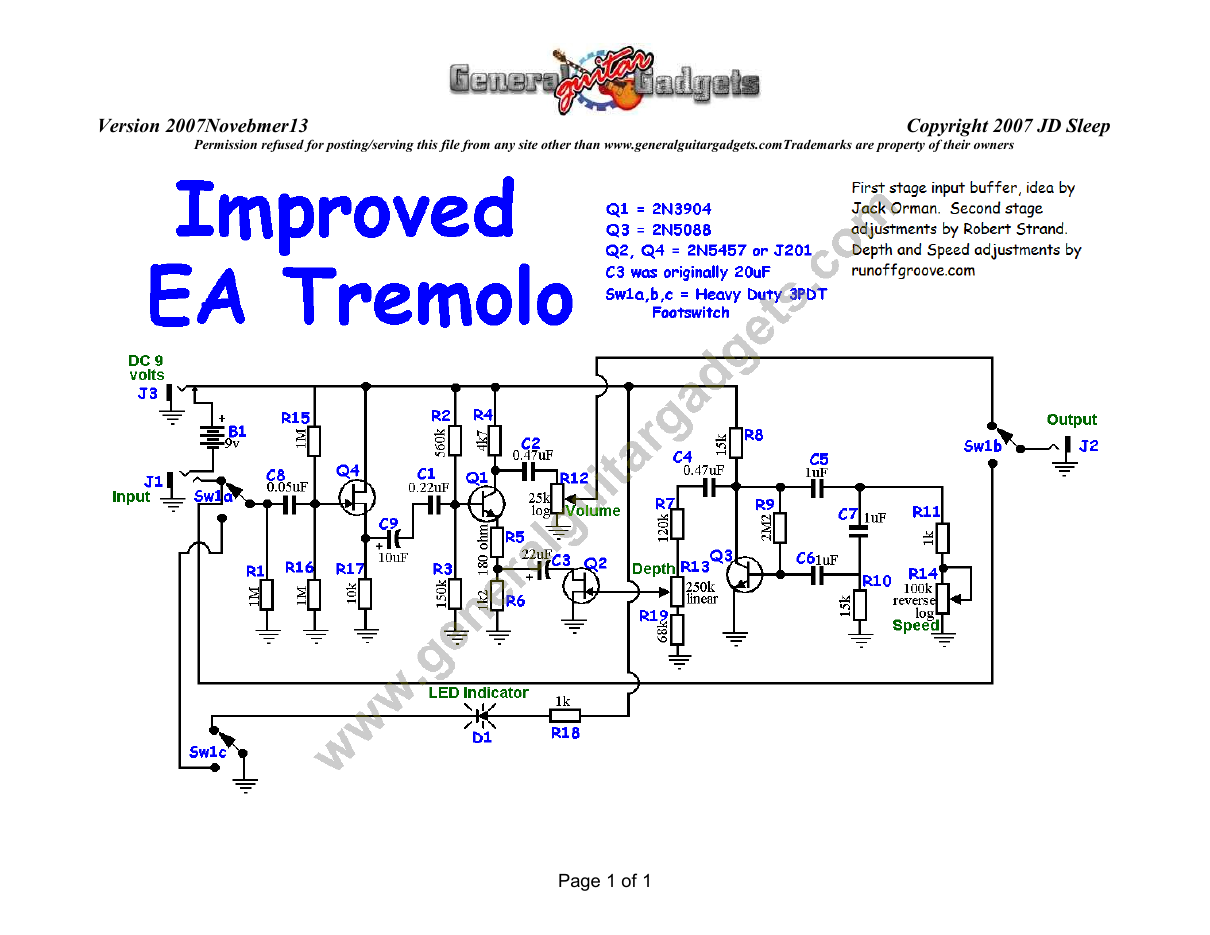
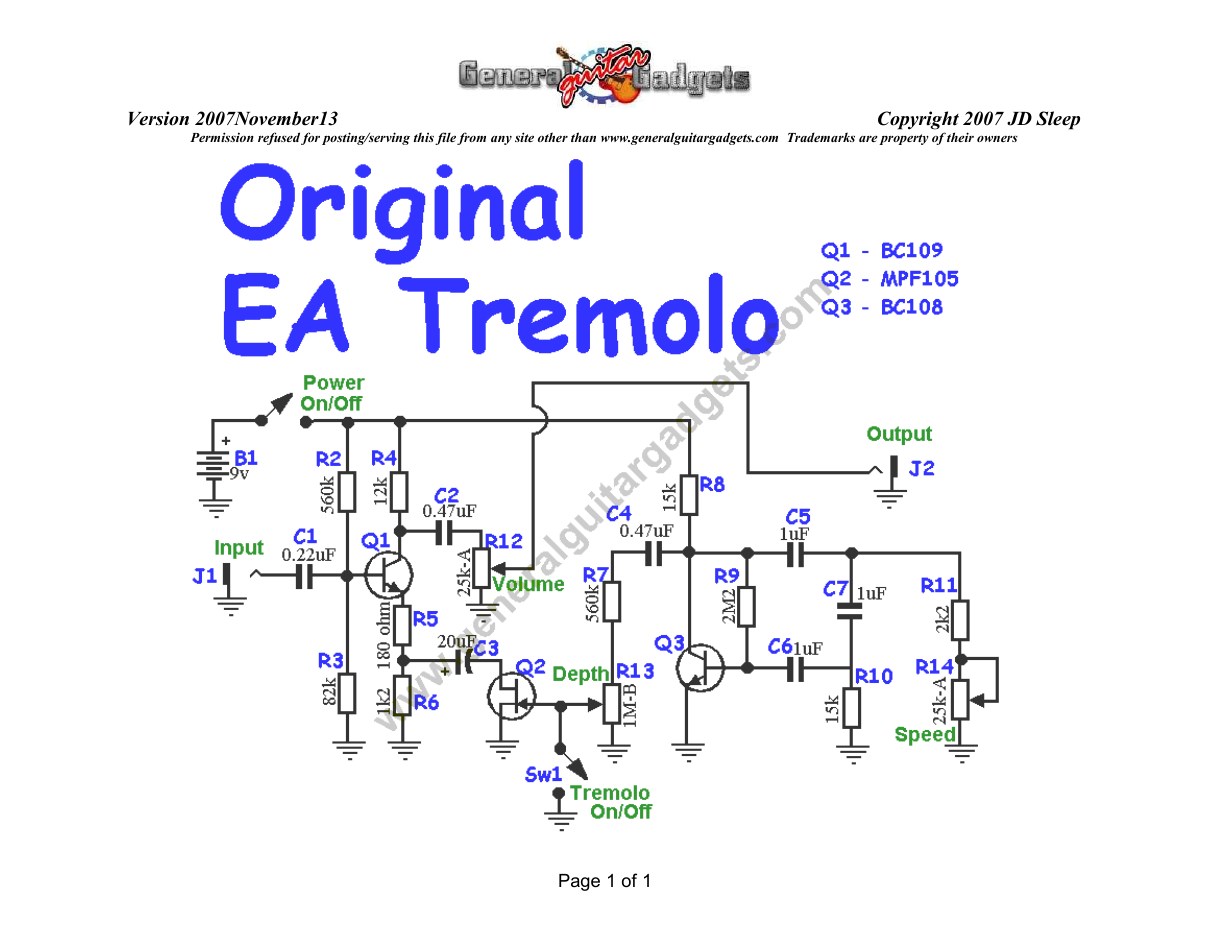
Parts layout
Parts Layout / Wiring Diagram
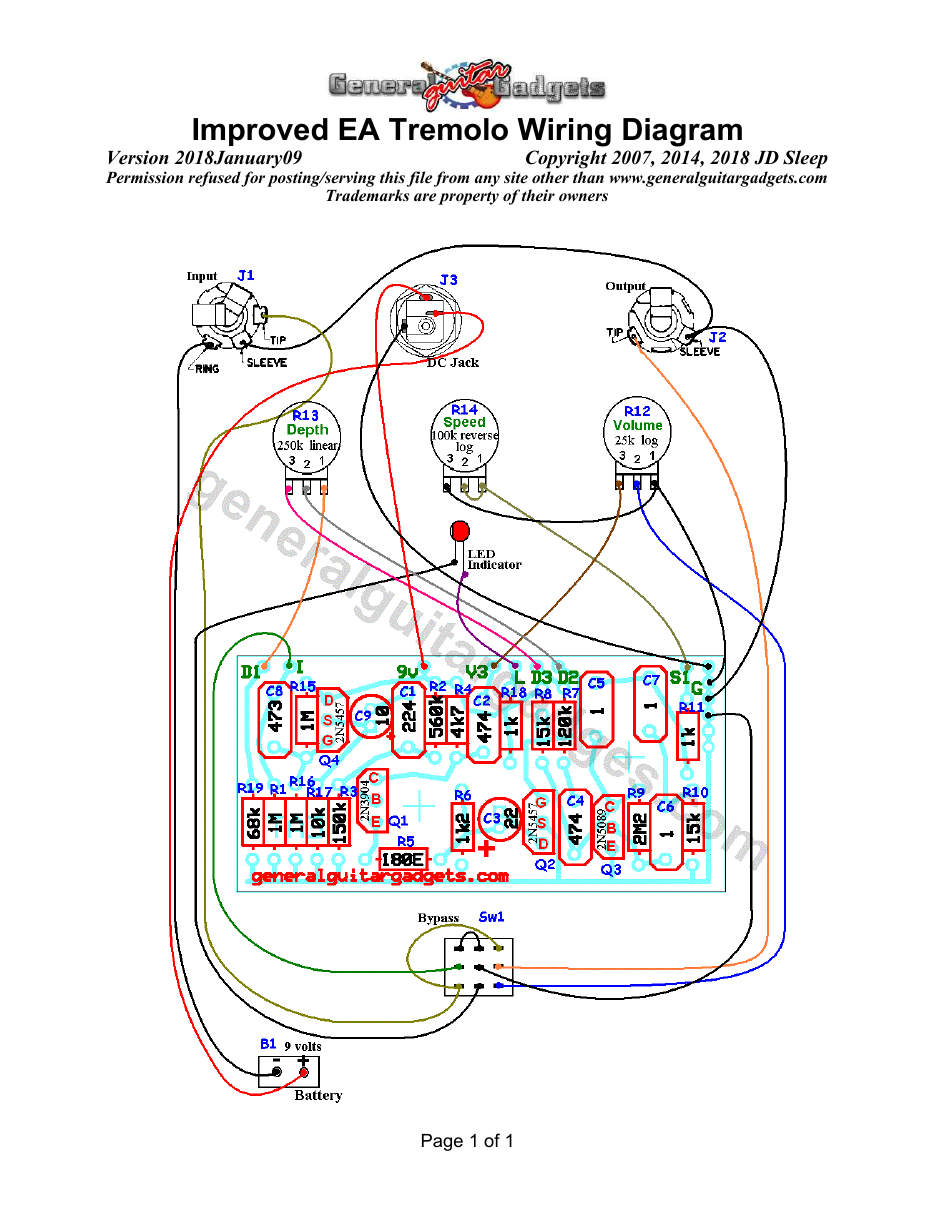
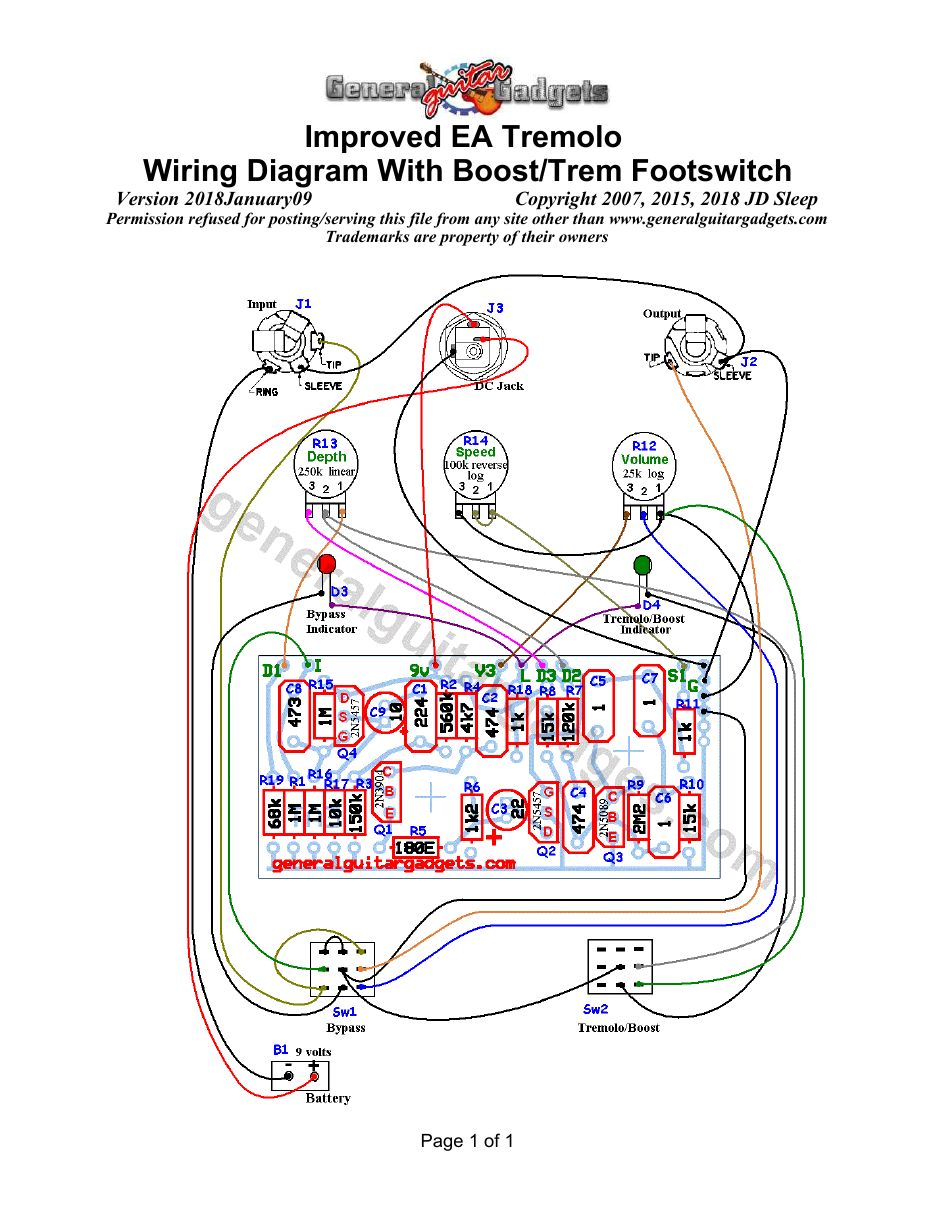
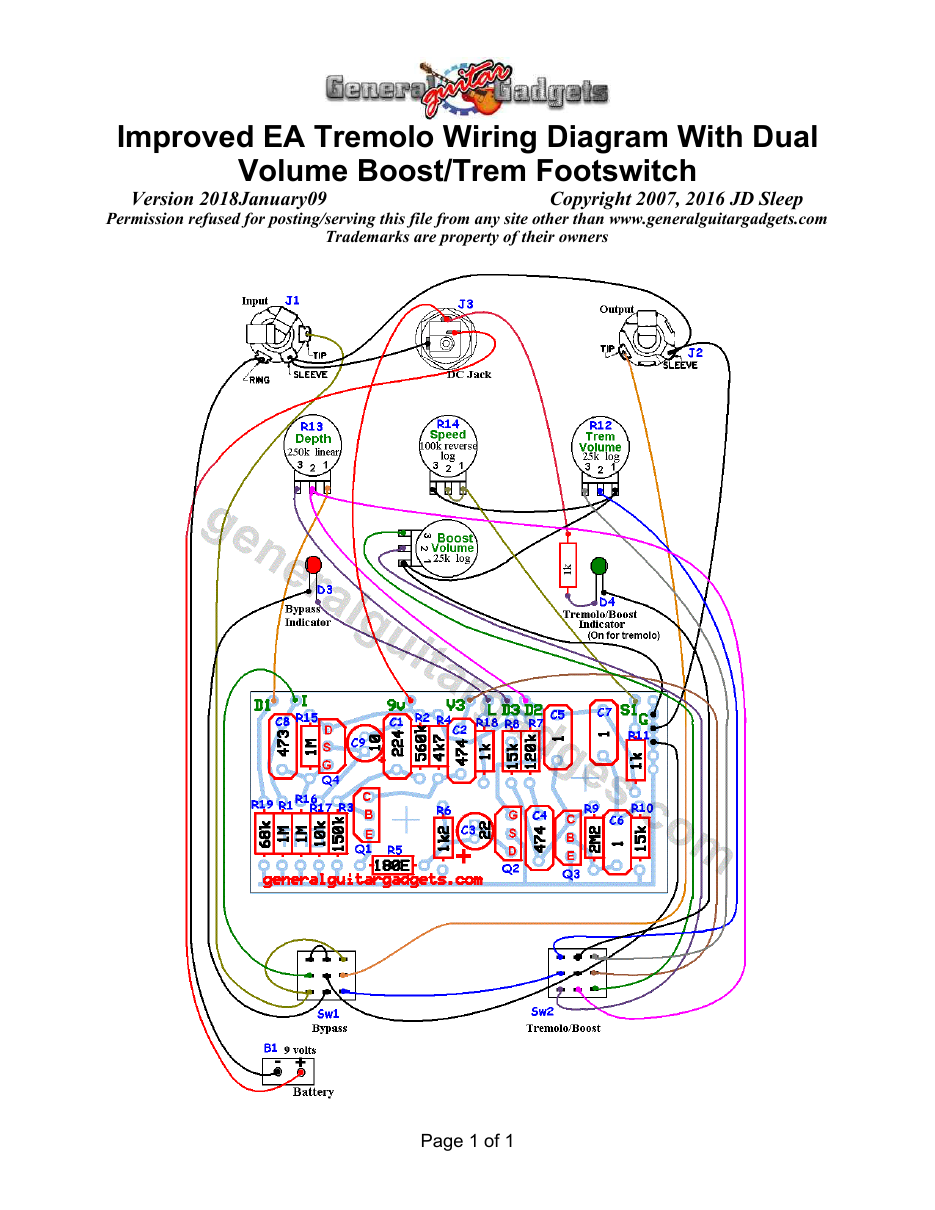
What you will need
Bill of Materials
Version 2009 · Copyright 2007 JD Sleep · Permission refused for posting/serving this file from any site other than www.generalguitargadgets.com · Trademarks are property of their owners
Resistors
| Resistor ID | Value | 3-band Marking | 4-band Marking |
|---|---|---|---|
| R1 | 1M | brown-black-green | brown-black-black-yellow |
| R2 | 560k | green-blue-yellow | green-blue-black-orange |
| R3 | 150k | brown-green-yellow | brown-green-black-orange |
| R4 | 4k7 (4.7k) | yellow-violet-red | yellow-violet-black-brown |
| R5 | 180 ohm | brown-gray-brown | brown-gray-black-black |
| R6 | 1k2 (1.2k) | brown-red-red | brown-red-black-brown |
| R7 | 120k | brown-red-yellow | brown-red-black-orange |
| R8 (without | 15k | ||
| flashing LED option) | brown-green-orange | brown-green-black-red | |
| R8 (with flashing | 10k | ||
| LED option) | brown-black-orange | brown-black-black-red | |
| R9 | 2M2 (2.2 M) | red-red-green | red-red-black-yellow |
| R10 | 15k | brown-green-orange | brown-green-black-red |
| R11 | 1k | brown-black-red | brown-black-black-brown |
| R12 | Potentiometer (see below) | ||
| R13 | Potentiometer (see below) | ||
| R14 | Potentiometer (see below) | ||
| R15 | 1M | brown-black-green | brown-black-black-yellow |
| R16 | 1M | brown-black-green | brown-black-black-yellow |
| R17 | 10k | brown-black-orange | brown-black-black-red |
| R18 | 1k | brown-black-red | brown-black-black-brown |
| R19 | 68k | blue-gray-orange | blue-gray-black-red |
Capacitors
| Capacitor ID | Value | Type | Possible Marking |
|---|---|---|---|
| C1 | 0.22µF | Film | 224 |
| C2 | 0.47µF | Film | 474 |
| C3 | 22µF | Aluminum Electrolytic | 22µF |
| C4 | 0.47µF | Film | 474 |
| C5 | 1µF | Film | 105 |
| C6 | 1µF | Film | 105 |
| C7 | 1µF | Film | 105 |
| C8 | 0.047µF | Film | 473 |
| C9 Potentiometers | 10µF Part Id | Aluminum Electrolytic | 10µF Value |
| R12 (Volume) | 25k log (25k A) | ||
| R13 (Depth) | 250k linear (250k B) | ||
| R14 (Speed) | 100k reverse log (100k C) |
Other
| Part ID | Part Name |
|---|---|
| Q1 | 2N3904 |
| Q2 | 2N5457 |
| Q3 | 2N5089 (or 2N5088) |
| Q4 | 2N5457 |
| J1 | Stereo quarter-inch jack |
| J2 | Mono quarter-inch jack |
| J3 | DC Jack |
| B1 | 9 volt battery (not included in the Kit) |
| Sw1 | Heavy Duty 3PDT footswitch (bypass) 9v battery snap, Printed Circuit Board, 24 gauge stranded wire, knobs enclosure |
How to build it
Instructions
Version 2008June01 · Copyright 2007 JD Sleep · Permission refused for posting/serving this file from any site other than www.generalguitargadgets.com · Trademarks are property of their owners
This is a tremolo project from the November 1968 issue of the Electronics Australia Magazine. This wonderful sounding tremolo was brought to the Internet by Greg Nabke and some great modifications have been posted over the years by Robert Strand, the folks at runoffgroove.com and others. Lots of "Boutique" effects builders have used this basic design for their tremolo units and lots of players and builders love this project because it sounds so good and is simple to build. The title of the project in the 1968 magazine issue was A Guitar Preamp with fully solid-state Vibrato. The term "vibrato" was misused here in the same way that Fender™ misused the term on their amplifiers, it is actually tremolo (tremolo being amplitude modulation, vibrato being pitch modulation). This project includes what we think are the best of the modifications for good depth and speed controls and for better use in a modern-day rig. We used some of the modifications to Speed and Depth from the runoffgroove.com site, but we decided against using the MOSFET first stage, due to the fact that MOSFET transistors are sensitive to failure due to exposure to common static electricity during installation. The JFET stage (first transistor stage in the circuit) we use sounds great. Note that these modifications are all part of the base project and therefore the name of the project is Improved EA Tremolo. There are more modifications above and beyond these with full instructions in the Improved EA Tremolo Modification Document. Unlike most tremolo units, this one has a Volume knob. This is a great feature that adds function and charm. Tremolo at unity gain gives the illusion of a volume loss, the volume control gives you the ability to fine tune the effect or go wild if needed.

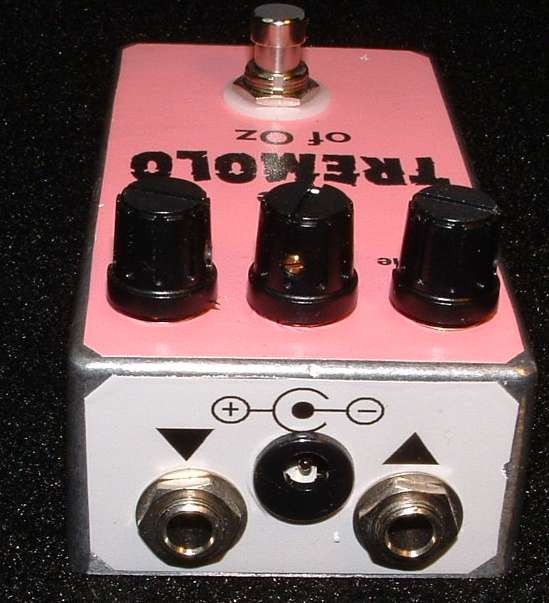
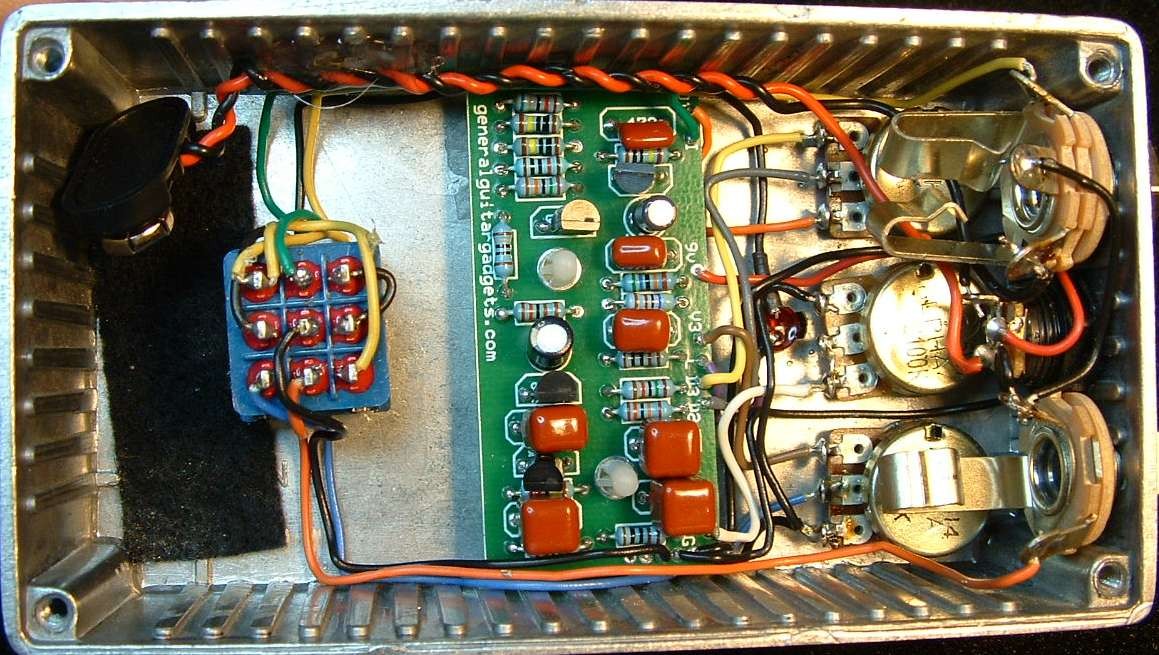
There is a lot of gain at the upper levels of the volume control. Also, there is an excellent booster modification listed in the Modifications document that makes good use of Volume Control. Use the project documents provided, starting with the General Build Instructions. Important Note: There is a minor error on some of the older PCB's screen print. The polarity of C3 is backwards. All the diagrams show the correct orientation, so refer to the part placement diagrams when installing the C3 polarized capacitor if you think you have an older PCB. It will actually work fine with the capacitor backwards, but the Booster modification won't work. There are some options for the LED indicators. A flashing LED can be installed to show the rate of speed of the tremolo. This can be installed as the bypass indicator, or as a separate indicator that can show the rate even when bypassed. The wiring diagrams and instructions for some of the wiring configurations for the LEDs are listed in the Modifications document. Here's an inside view of the unit we built to give you some general ideas if needed.
Comments and questions are welcome and can be sent to [email protected] Here is a chart of voltages taken at the transistor pins. This information can be used to help you find and fix problems if your EA Tremolo doesn't work when you test it.
Component
Location
9 volt power supply Q1
Q2
Q3
Q4
Voltage
8.8v
Collector
6.0v
Base
1.4v
Emitter
0.8v
Drain
0.0v
Source
0.0v
Gate
variable
Collector
variable (with Speed Knob)
Base
0.6v
Emitter
0.0v
Drain
8.8v
Source
5.0v
Gate
4.1v
Make it your own
Modification Instructions
Version 2007November15 · Copyright 2007 JD Sleep · Permission refused for posting/serving this file from any site other than www.generalguitargadgets.com · Trademarks are property of their owners
This document outlines some modifications that can be done to this project.
Flashing LED Modification
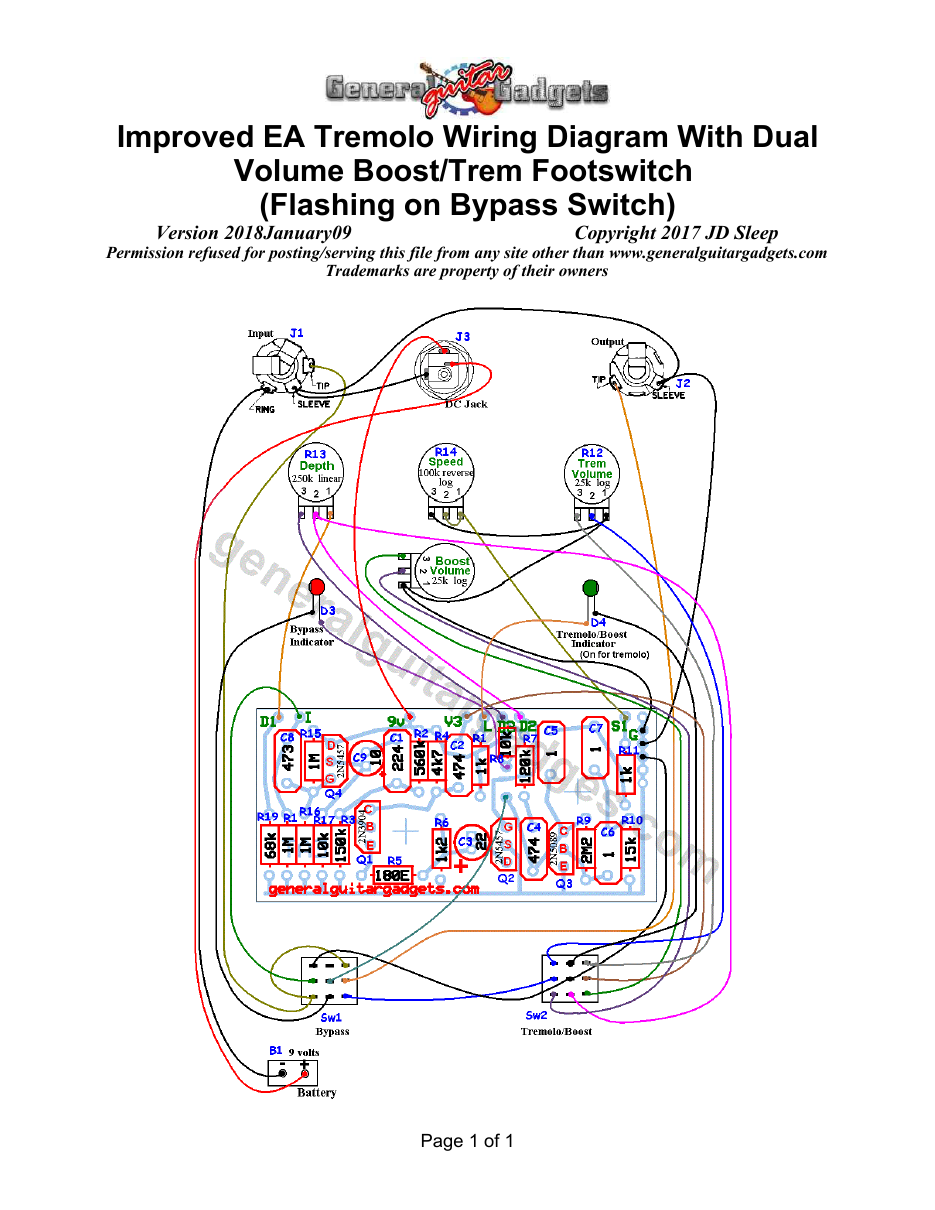
The first modification is to install a flashing LED. The LED will flash in time with the tremolo speed which may be useful or at least neat to look at. The way this modification works is to replace R8 (15k) with a 10k resistor and an LED in series. It's as simple as that. The PCB includes extra pads to do this and R8 (10k) should be installed standing on-end. There are at least a couple ways to wire the flashing LED. One way is to have two LEDs on your box, one for the Bypass indicator and another for the speed rate as shown in this diagram:
The additional LED will flash in time with the speed rate even when bypassed.
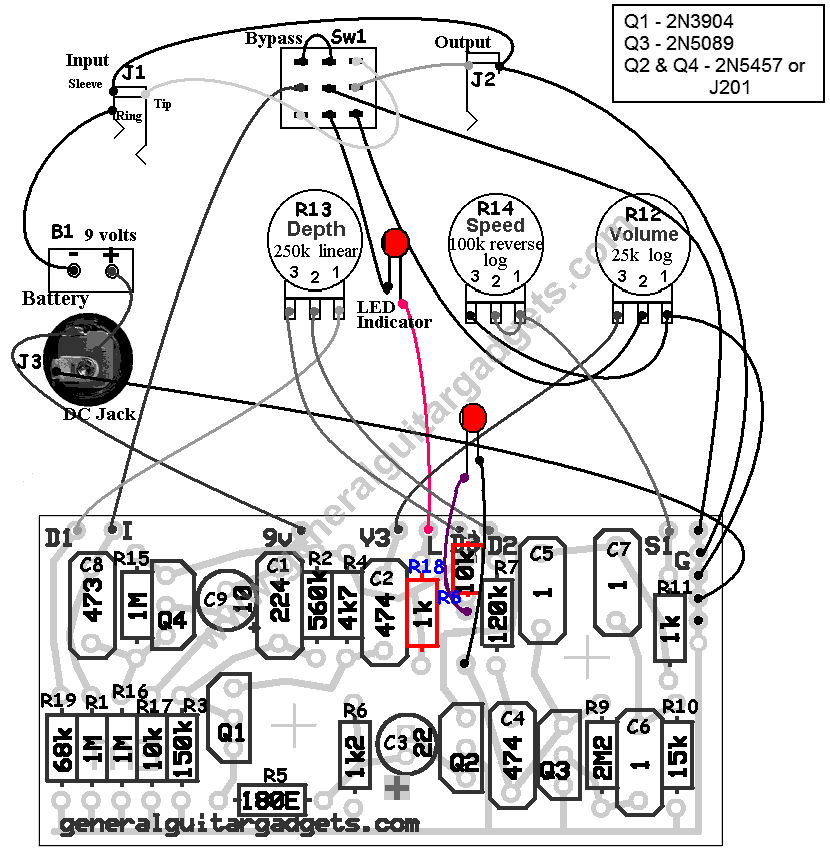
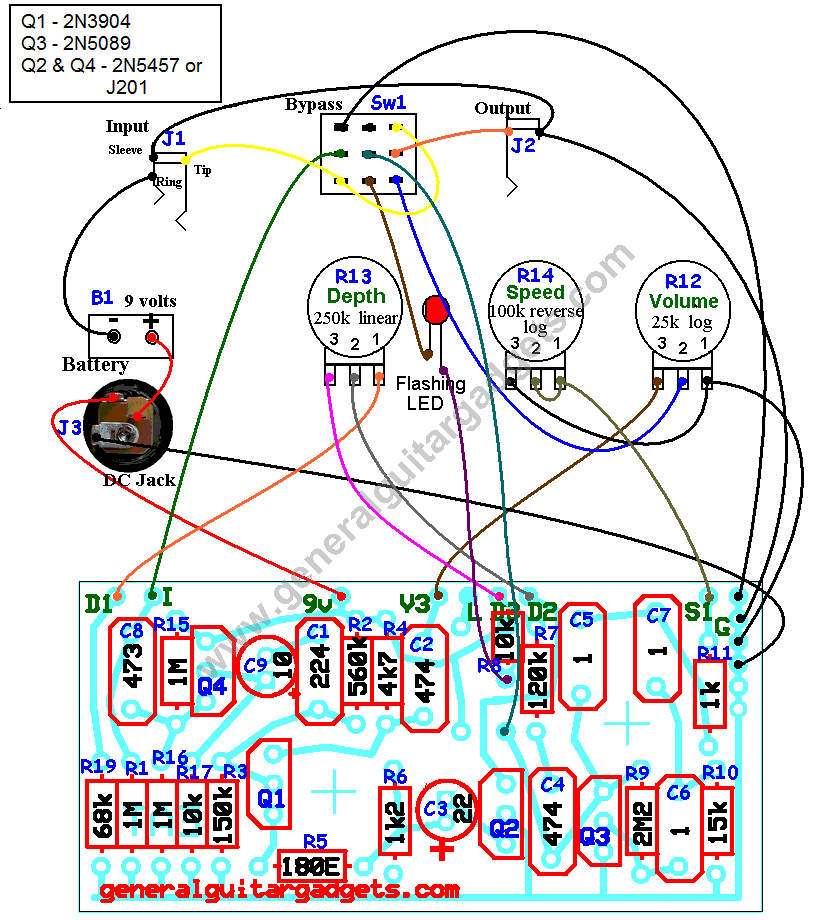
Another way to wire the flashing LED is to have a "dual-duty" LED that serves as true-bypass indicator and flashes at the speed rate. The following diagram illustrates how to wire to this configuration:
Booster Modification
The original article used a shunt switch to turn the tremolo on and off, shunting the LFO output to ground to kill the tremolo, leaving the "preamp" in the signal chain at all times. This method of switching the tremolo effect on and off has been replaced by true bypass on all the modern versions, as we have done in this project. But what is it that really makes this tremolo pedal sound so good? What makes this unit so much better than so many of the other tremolo pedals? We believe that it is not so much the section of the circuit that modulates the amplitude, but it is a preamp with beautiful tone! You'll appreciate what we mean by beautiful tone if you try this modification. All we do for this modification is to incorporate the original shunt switch back into the circuit and we have a dual-duty Booster(Preamp)-Tremolo Unit as it was originally intended. This modification is so simple it's ridiculous. Just add a SPST toggle switch wired as shown in the following diagram. One lug to the Depth control wiper and the other lug to any ground point.
Note that we still retain the true bypass so that you can still take the pedal out of your
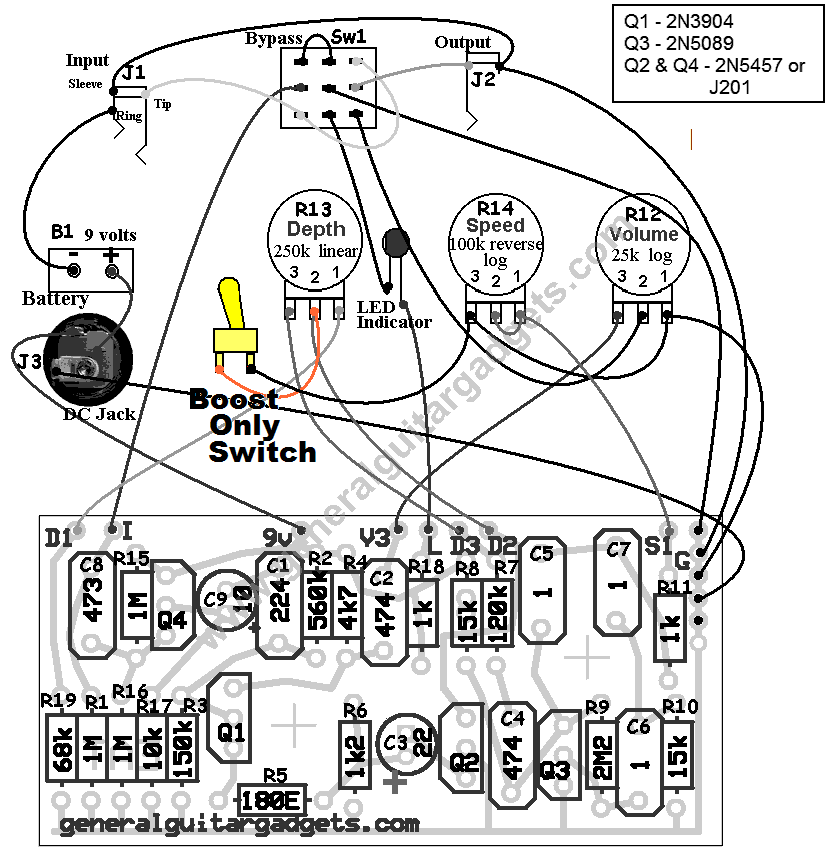
signal chain if you wish, but the extra switch just cuts the tremolo effect and lets you use the "preamp" section of the circuit as a really nice booster. The switch could be an additional footswitch if you are so inclined. Comments and questions are welcome and can be sent to [email protected]
More about this project
Notes, sounds and related links
Would you like a Ready to Solder Circuit Board for this project? Note: If you buy the kit, the Ready-to-Solder Printed Circuit Board (RTS PCB) is included in the kit. You do not need to purchase this Ready to Solder Circuit Printed Board if you buy the kit.

Ready to build? We have the kit.
Buy a EAT Complete Kit. Includes all the parts and materials you need to build one, all for about the price you would pay for a PCB and parts.
