
Project · Boosters & Volume
EHX™ LPB2™ Replica
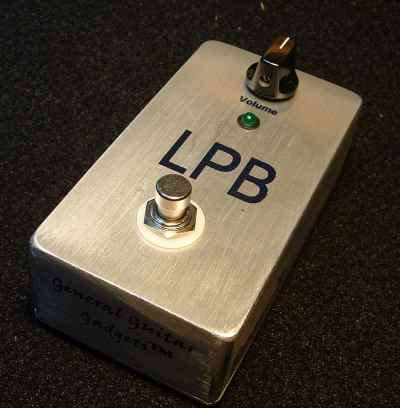
This project is a replica of the original vintage Electro-Harmonix™ LPB1 (Linear Power Booster) or LPB2™. The only difference between an LPB1 and LPB2™ was the enclosure and switch, LPB1 plugs into your guitar, LPB2™ is a stompbox. We named this project CB1 (Clean Boost 1) and it is a stompbox version similar to the LPB2™. The LPB2™ is actually a much better boost (less ugly distortion) if you move the volume to the front of the circuit instead of the stock version where the volume is at the end. Schematic and diagrams of the input volume mod are listed below. Trademarks mentioned here belong to their owners and not to General Guitar Gadgets
Project files
Everything you need to build it
CB1 Ready-For-Transfer Printed Circuit Board Layout - For use only if you are a complete DIY person who wants to etch and drill your own PCB. Otherwise, we recommend you ignore this PCB mask and buy the Ready to Solder Printed Circuit Board or Complete Kit.
Schematic
Schematic
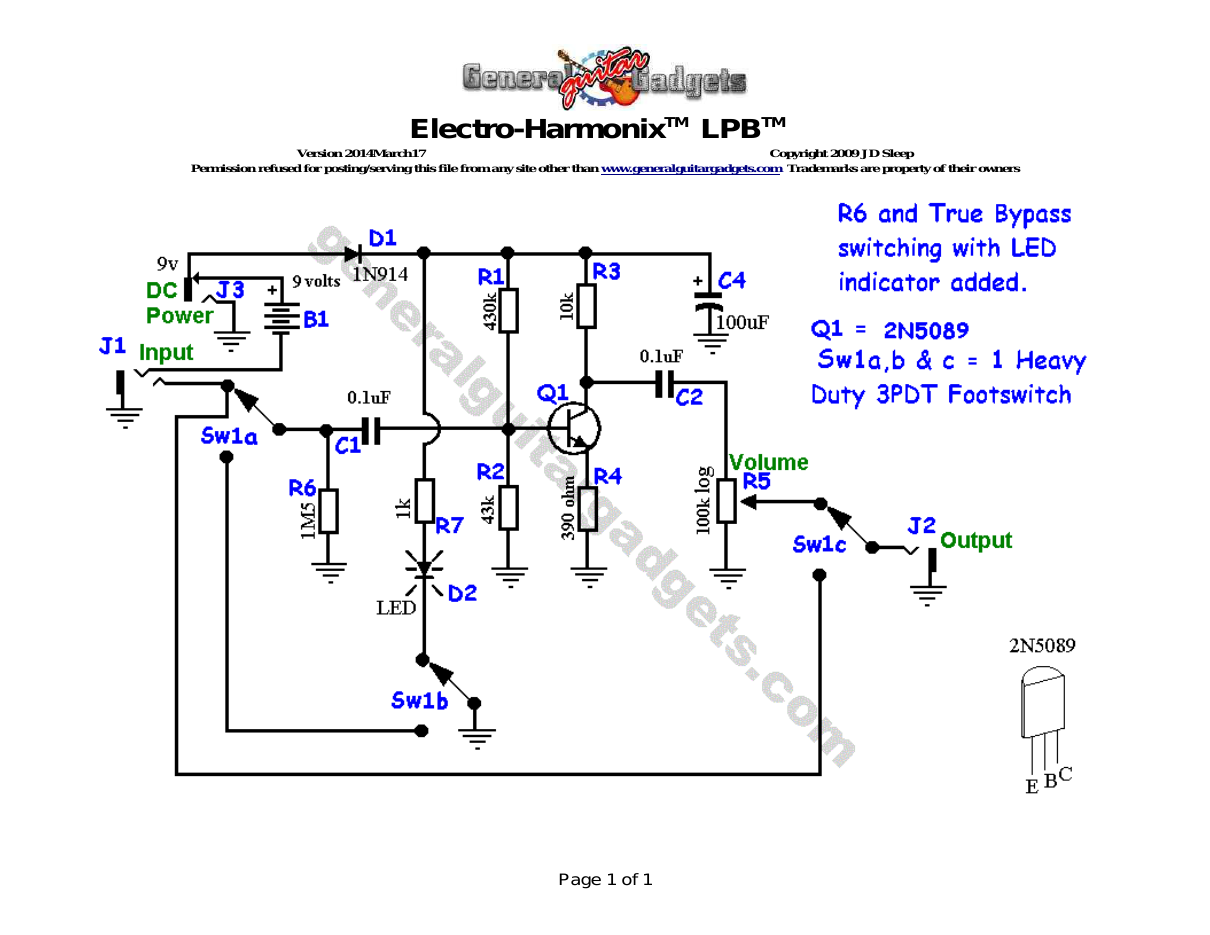
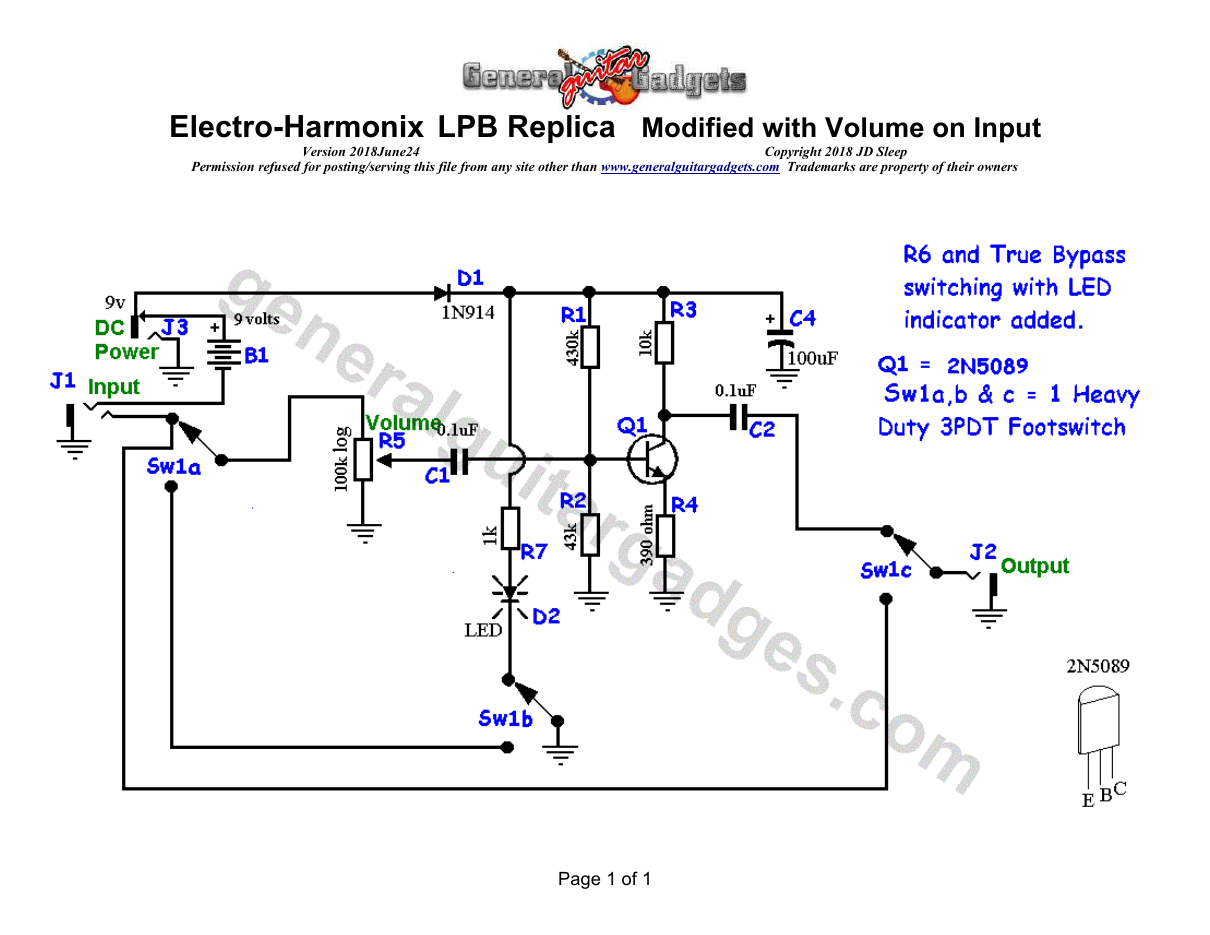
Parts layout
Parts Layout / Wiring Diagram
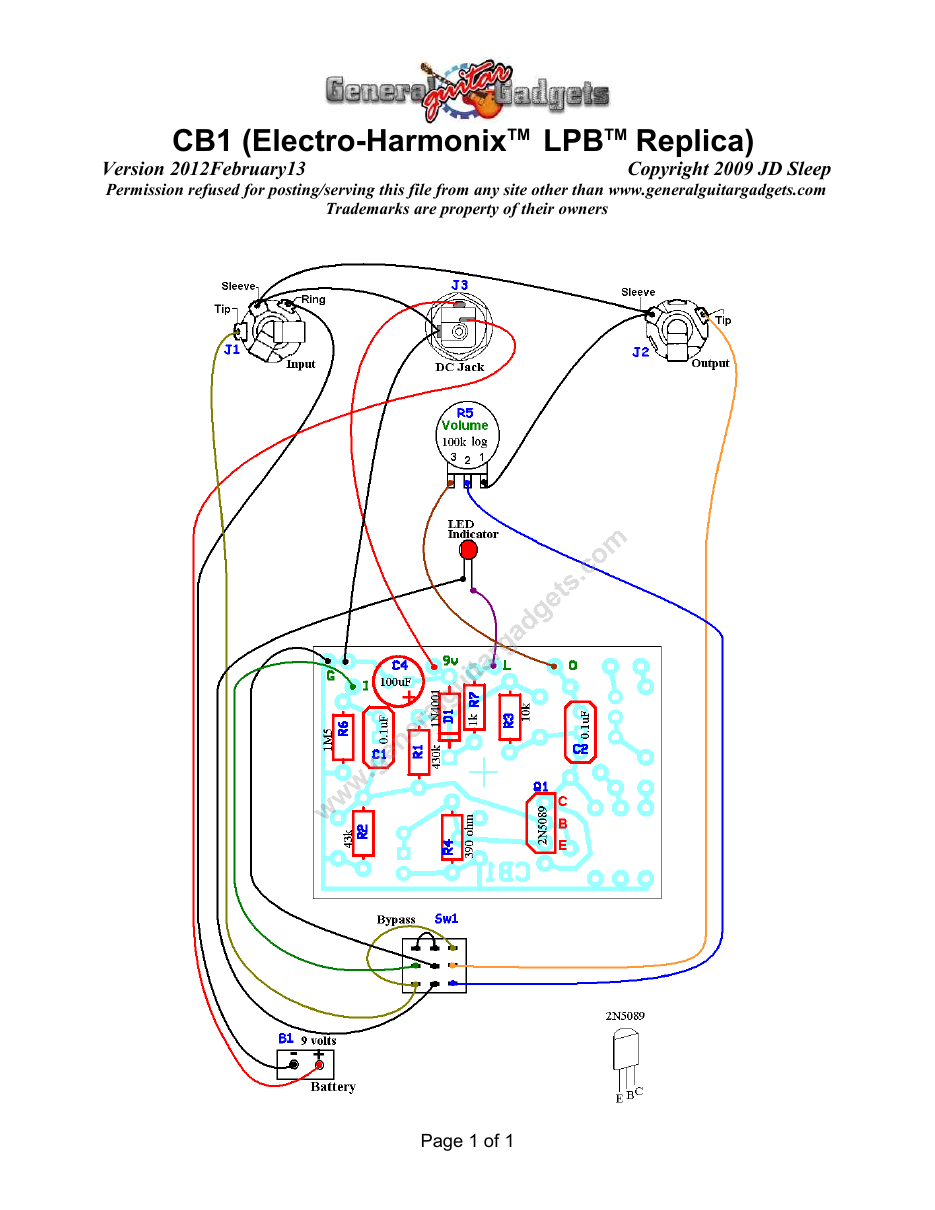
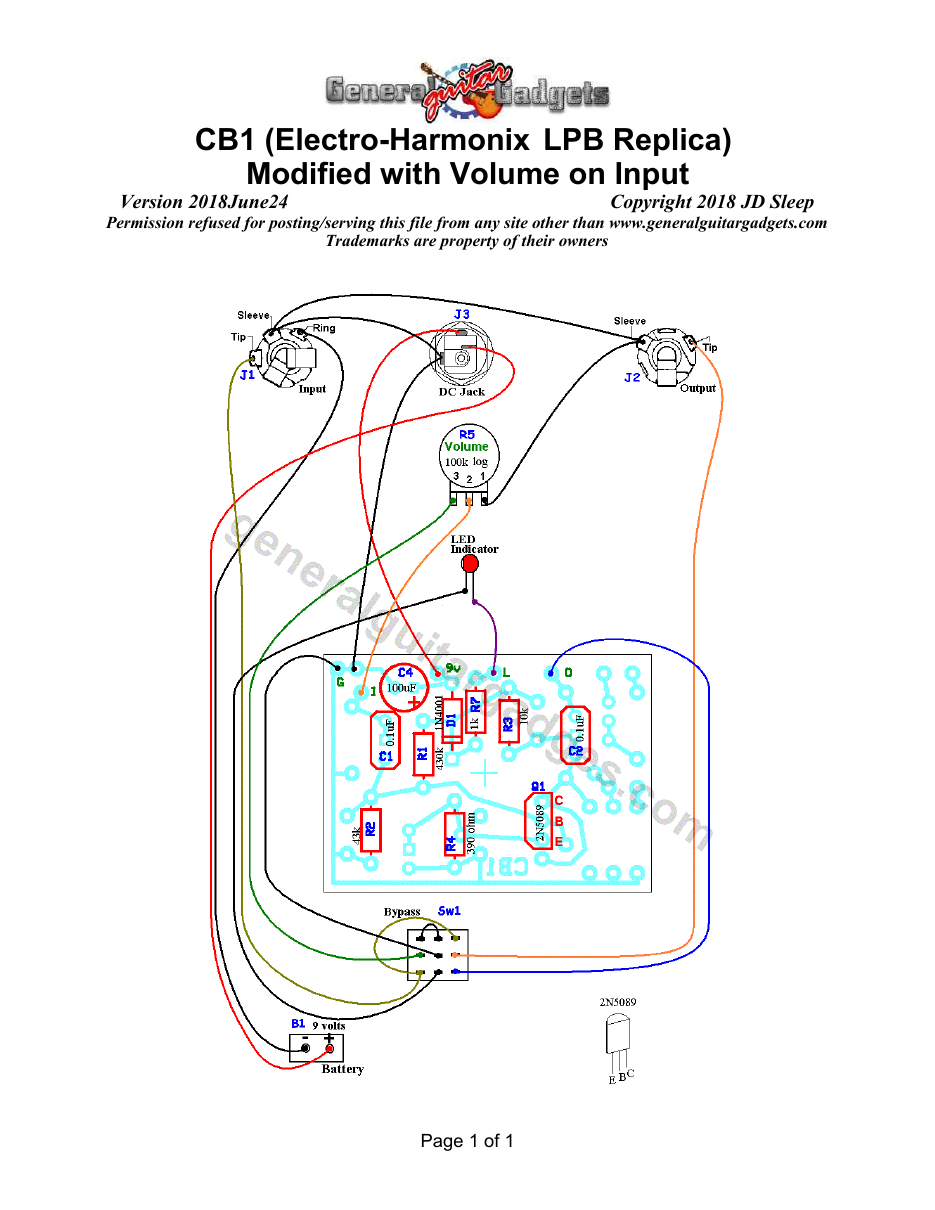
What you will need
Bill of Materials
Version 2009July03 · Copyright 2007 JD Sleep · Permission refused for posting/serving this file from any site other than www.generalguitargadgets.com · Trademarks are property of their owners
Resistors
| Resistor ID | Value | 3-band Marking | 4-band Marking |
|---|---|---|---|
| R1 | 430k | yellow-orange-yellow | yellow-orange-black-orange |
| R2 | 43k | yellow-orange-orange | yellow-orange-black-red |
| R3 | 10k | brown-black-orange | brown-black-black-red |
| R4 | 390 ohm | orange-white-brown | orange-white-black-black |
| R5 | (Potentiometer) | ||
| R6 | 1M5 (1.5M) | brown-green-green | brown-green-black-yellow |
| R7 | 1k | brown-black-red | brown-black-black-brown |
Capacitors
| Capacitor ID | Value | Type | Possible Marking |
|---|---|---|---|
| C1 | 0.1µF | Film | 104 |
| C2 | 0.1µF | Film | 104 |
| C3 | none | ||
| C4 | 100µF | Aluminum Electrolytic | 100µF |
Potentiometers
| Part ID | Value | Type |
|---|---|---|
| R5 - Volume Control | 100k | Log (or Audio) Taper |
Other
| Part ID | Part Name |
|---|---|
| D1 | 1N914 |
| D2 | LED |
| Q1 | NPN bipolar junction transistor |
| J1 | Stereo quarter-inch jack |
| J2 | Mono quarter-inch jack |
| J3 | DC Jack |
| B1 | 9 volt battery (not included in the Kit) |
| Sw1 Examples of other NPN bipolar junction transistors: ● 2N5088 (original) ● 2N5089 (low noise version of 2N5088) ● 2N3904 ● 2N4401 ● many others | Heavy Duty 3PDT foot switch 9v battery snap, Printed Circuit Board, 24 gauge stranded wire, Enclosure, Knobs |
How to build it
Instructions
Version 2018June25 · Copyright 2009, 2018 JD Sleep · Permission refused for posting/serving this file from any site other than www.generalguitargadgets.com · Trademarks are property of their owners
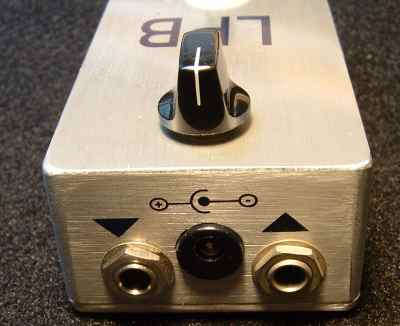
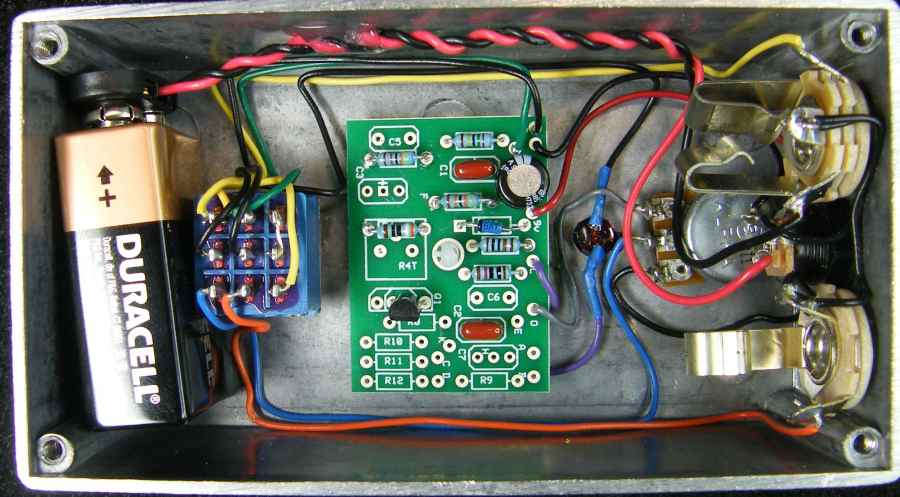
This booster is an easy to build project that will produce a good clean boost to your guitar signal. The booster has many applications, including driving the tube preamp in your amplifier into nice distortion, driving other effects into new sonic territory or simply bringing up the volume of an effects loop when needed for lead guitar solos. It is highly recommend (by General Guitar Gadgets) to use the input volume modification as shown on the project page, especially for guitars with high-gain pickups. Use the project documents provided, starting with the General Build Instructions. The circuit is a single transistor stage that will give the signal some amplification. Clean and transparent. Here's an inside view of the unit we built to give you some general ideas if needed.
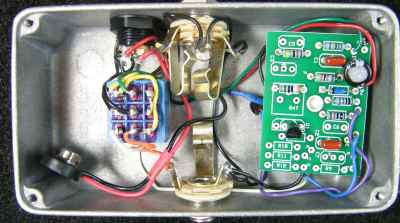
Here's a view of what it looks like with the 1590B (smaller box) option. Note that you don't use the plastic PCB standoff, you use some double sided tape and set the PCB on top of the back of the pot.
Here is a chart of voltages taken at the transistor pins. Use these voltages as a guideline. You may not get the exact readings listed, but should be somewhere in the area.
Component
Location
9 volt power supply Q1
Voltage
9v
Collector
4.7v
Base
0.8v
Emitter
0.2v
Make it your own
Modification Instructions
Version 2018June25 · Copyright 2012, 2018 JD Sleep · Permission refused for posting/serving this file from any site other than www.generalguitargadgets.com · Trademarks are property of their owners
Volume Potentiometer Location
The volume control on this and many other boosters can be on the circuit input or on the output. The original units have the volume on the output. Most stompboxes have the volume on the output, most amps have volume on the input. There are trade-offs between choosing to put the volume on the input or the output. Volume on Output Pros: Noise level of the circuit (some hiss from the transistor) is controlled by the volume. At low volume boost the background hiss is also lower. Cons: The circuit always takes the full force of gain from the input Volume on Input Pros: Input level into the circuit is controlled by the volume Cons: Noise level of the circuit (some hiss from the transistor) can be heard full force even when volume is low. Since the LPB is known to distort badly with high-gain pickup guitars pushing it and since the hiss noise level is very low, modifying to put the volume pot on the input is a good choice. Out tests have concluded that with the volume on input, it will handle guitars with humbucker pickups without the ugly distortion and it has a much more crisp, clean sound, even with single coil guitars. This is a highly recommended modification.
Transistor Selection
The schematic link shows the transistor (Q1) as 2N5133 and notes that a BC239 was also used. My (JD's) original LPB1, purchased in the mid '70's has a 2N5088 transistor in it. We recommend using a 2N5089 or 2N5088, since they are low noise and readily available.
Gain Changing Modifications
The LPB is a simple version of a “Common Emitter Amplifier”. The overall gain characteristics of this circuit can be tweaked by changing the value of the four resistors connecting to the transistor. Rather than repeat lengthy discourse on how to do this, you can learn more about this by an internet search on Common Emitter Amplifiers. We will suggest that the gain on this circuit is about as high as you would want to go and if it doesn’t provide enough loudness, you should probably consider other circuit options for boost or pre-amping. For those of you who haven’t heard an LPB1 or LPB2™ booster, it is a LOUD booster! Providing as much volume (or more) as the MXR™ MicoAmp or Dan Armstong Red Ranger™ or any other booster we have
used.
Tone Changing Modifications
This layout can be used to create a "Screaming Bird" by simply substituting the 0.1uF capacitors with 0.002uF capacitors. We've never heard any thing good said about The Screaming Bird or Screaming Tree. As Art Thompson says, the Screaming Tree "Should have been called The Screaming Audience"! The old Screaming Bird/Tree treble boosters are pretty harsh to most ears. Capacitors with values between 0.047µF and 0.0047µF would work well for milder treble boost. Brian Tremblay reported that 0.01µF caps worked well for a treble boost without being too ear piercing.
Want to contribute? If you are happy to share your modification information with other builders, contact us at [email protected]. If the modifications pass our review we will add it to this file for all to enjoy!
More about this project
Notes, sounds and related links


Other Information about the EH LPBs
electro-harmonix™ touted the following claims in a series of ads in 1975/76 Guitar Player Magazine:
- It's as if you had 20 sets of pick-ups all in one guitar.
- Maximum setting of the volume control of one unit can make your amplifier TEN times louder
- Increase guitar SUSTAIN.
- Vastly increases the performance of all distortion devices, wah-wah pedals and other accessories.
- Using two LPB's will give you even more sustain. Turning up the volume level of the first LPB past the halfway point will shift the second LPB into overdrive. Using the first LPB control, you can now develop distortion to any desired degree. The second LPB can control the volume of the combination.
All of these claims were backed up by a guaranteed full refund if you're not happy after a 10 day trial period!
The June '95 edition of Guitar Player ran an article entitled "Stompbox Stampede". The author Art Thompson, claims the LPB1 "...sounded way badder..." than the MXR™ Micro Amp. And that is Art Thompson's opinion, not necessarily ours.
One of the most interesting aspects of the original LPB1 is that it is one of the few guitar effect ever to be actually wired "point-to-point". No board, no terminal strip, just the parts dangling in mid air, mostly held in place by the solder connections to the mini pot.
Ready to build? We have the kit.
Buy a CB1 Complete Kit. Includes all the parts and materials you need to build one, all for about the price you would pay for a PCB and parts.

Would you like a Ready to Solder Circuit Board for this project? Note: If you buy the kit, the Ready-to-Solder Printed Circuit Board (RTS PCB) is included in the kit. You do not need to purchase this Ready to Solder Circuit Printed Board if you buy the kit.