
Project · Distortion
Marshall™ The Guv'nor
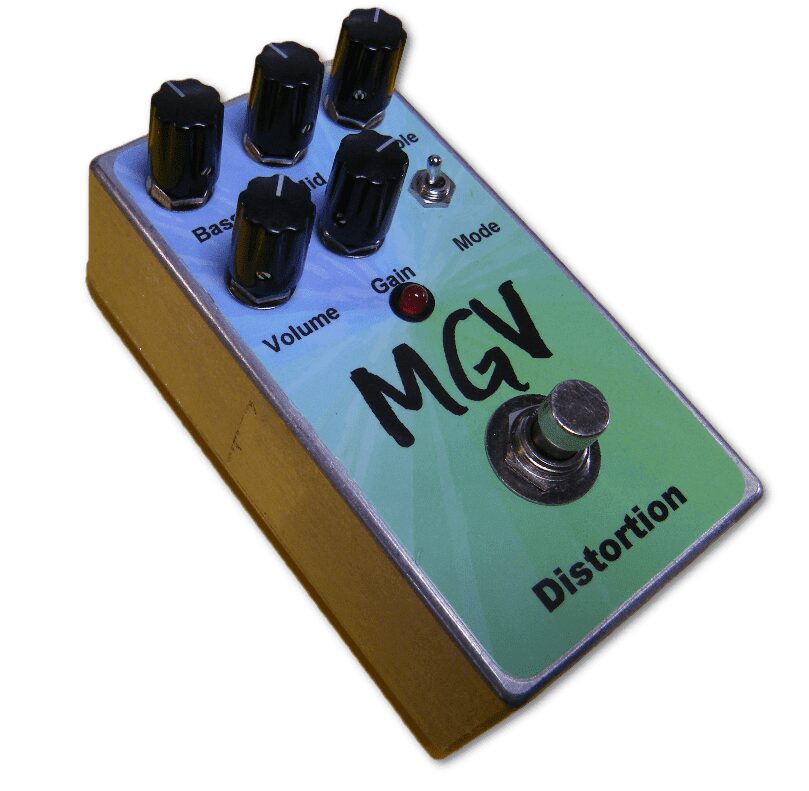
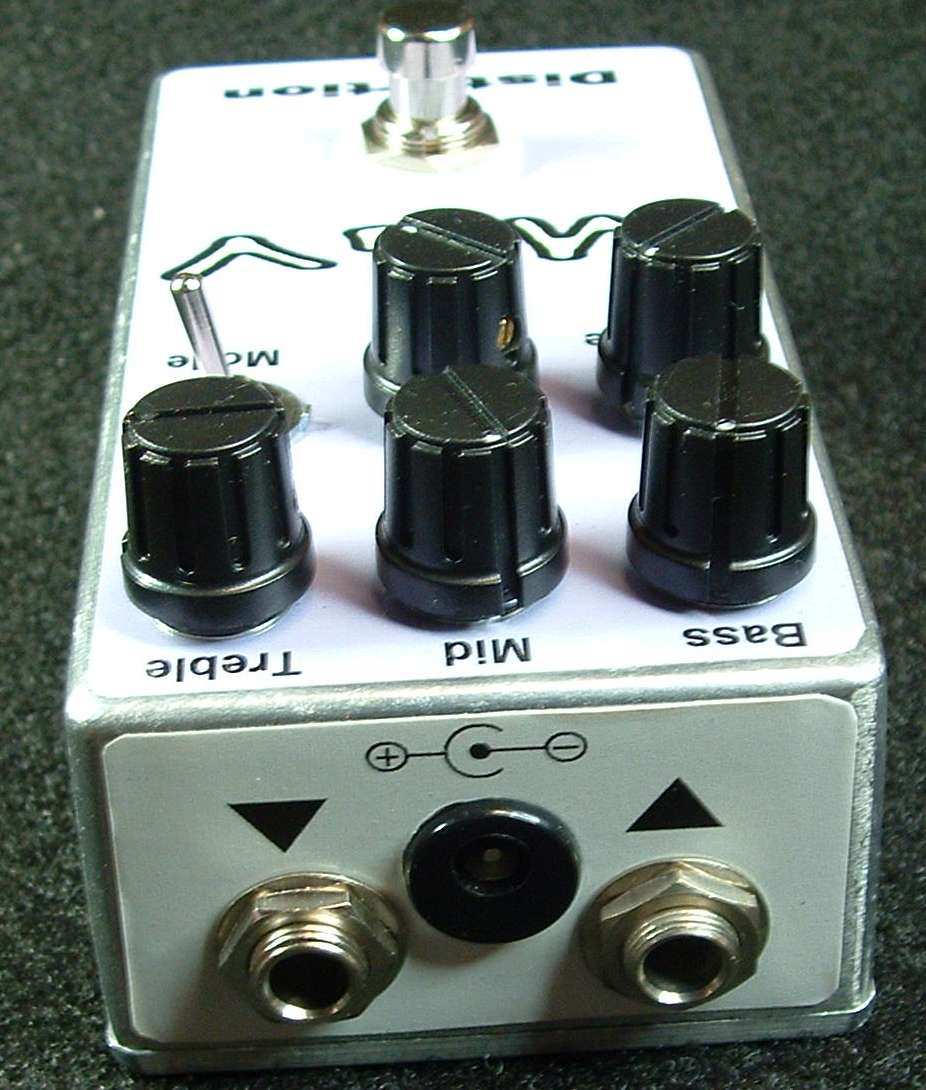
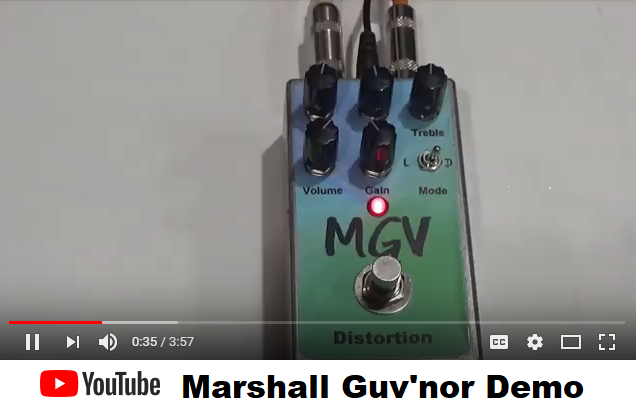
This project is based on the Marshall™ The Guv'nor and also the Danelectro Daddy-o, which is basically the same circuit as The Guv'nor with input and output buffers added. This is the circuit for the original black unit from the 1980's, not any of the later, inferior versions. This is a very versatile distortion effect, one of the best ever made in our opinion. With the tone controls, it is possible to get a nice variety of sounds.
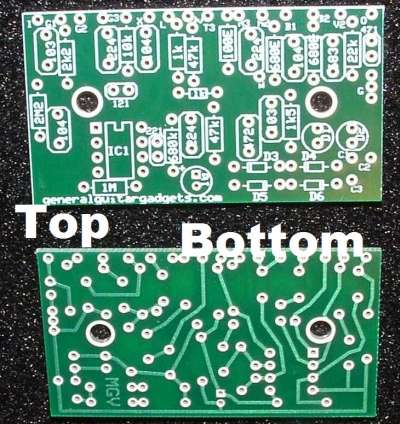
We utilized the space in the lower right section of the PCB to install the clippers and wired them to the toggle switch. This adds another set of sounds to the effect.
Any trademarks mention on this page belong to their rightful owners and not to General Guitar Gadgets
The story
About the circuit
Marshall™ released The Guv'nor in 1988, a British-made black pedal meant to put a cranked Marshall™ stack in a box, and it became famous as the distortion on Gary Moore's "Still Got the Blues." The circuit is an op-amp gain stage followed by a pair of LEDs clipping the signal to ground, then a full bass-middle-treble tone stack and an effects loop. Marshall™ moved production to Korea in the 1990s with changes that most players consider a step down, and Danelectro's Daddy-O of the same era is essentially the original Guv'nor circuit with input and output buffers added.
This project at GGG
The Guv'nor was on JD's original project list, one of the layouts he drew from the schematics the DIY community had worked out, and it has never left the site. We based our replica on the original black British unit, not the later versions, and when we laid out the current board there was room in the lower corner for a second pair of clipping diodes, so we wired them to a toggle switch and gave the pedal a second voice; the layout shows the switch wiring. With the three-band tone stack it is one of the most versatile distortions on the site.
Project files
Everything you need to build it
MGV Ready-For-Transfer Printed Circuit Board Layout - For use only if you are a complete DIY person who wants to etch and drill your own PCB. Otherwise, we recommend you ignore this PCB mask and buy the Ready-to-Solder Printed Circuit Board or Complete Kit from the links below.
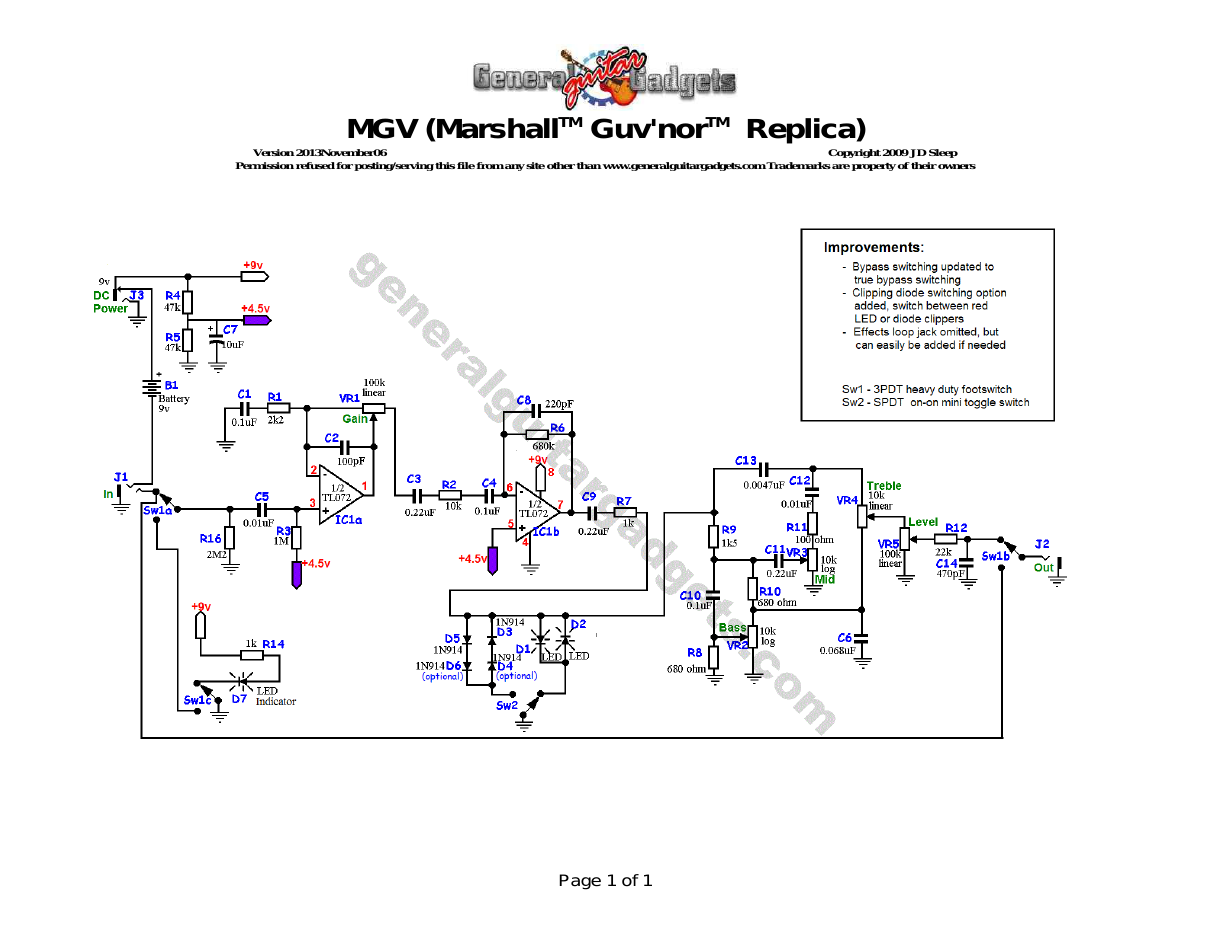
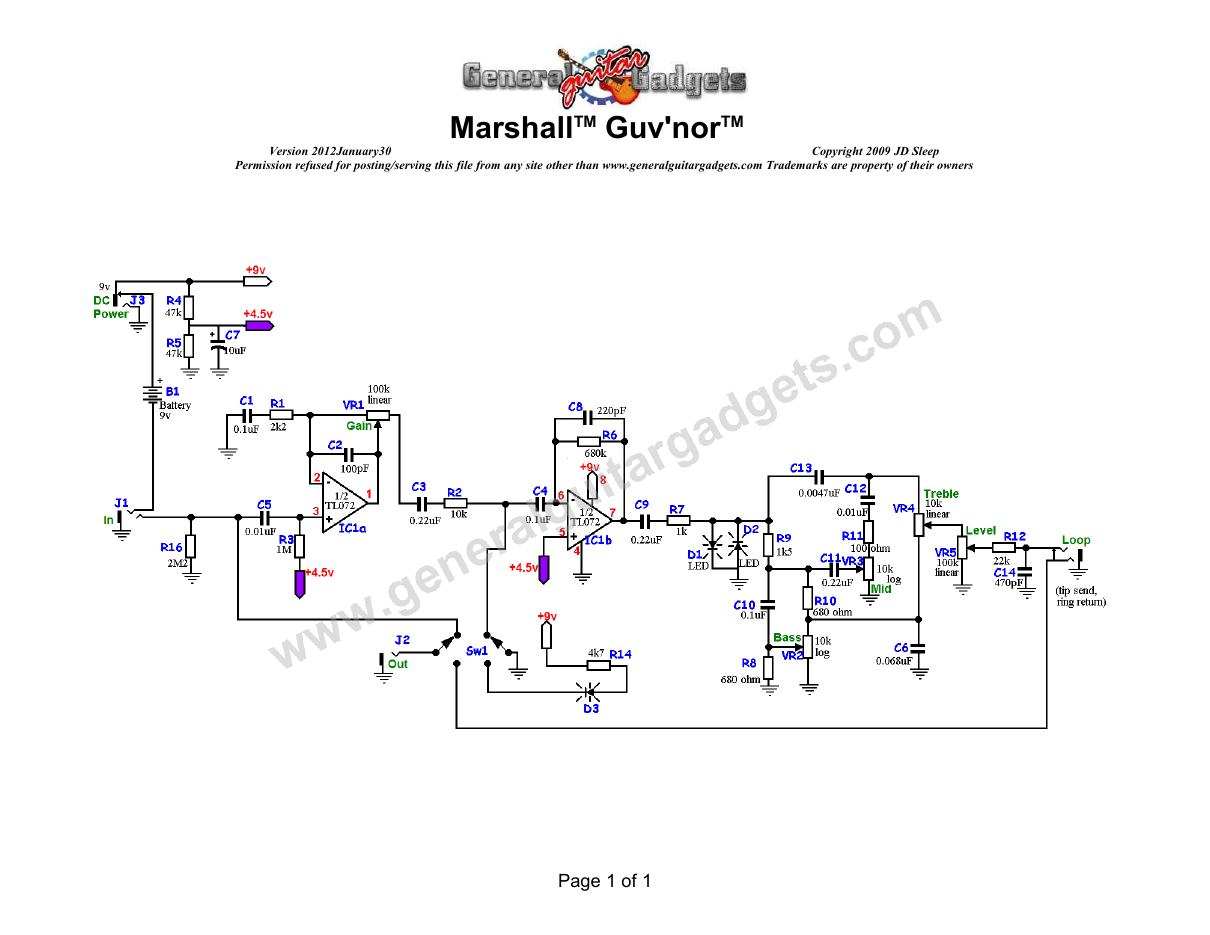
Schematic
Schematic
Parts layout
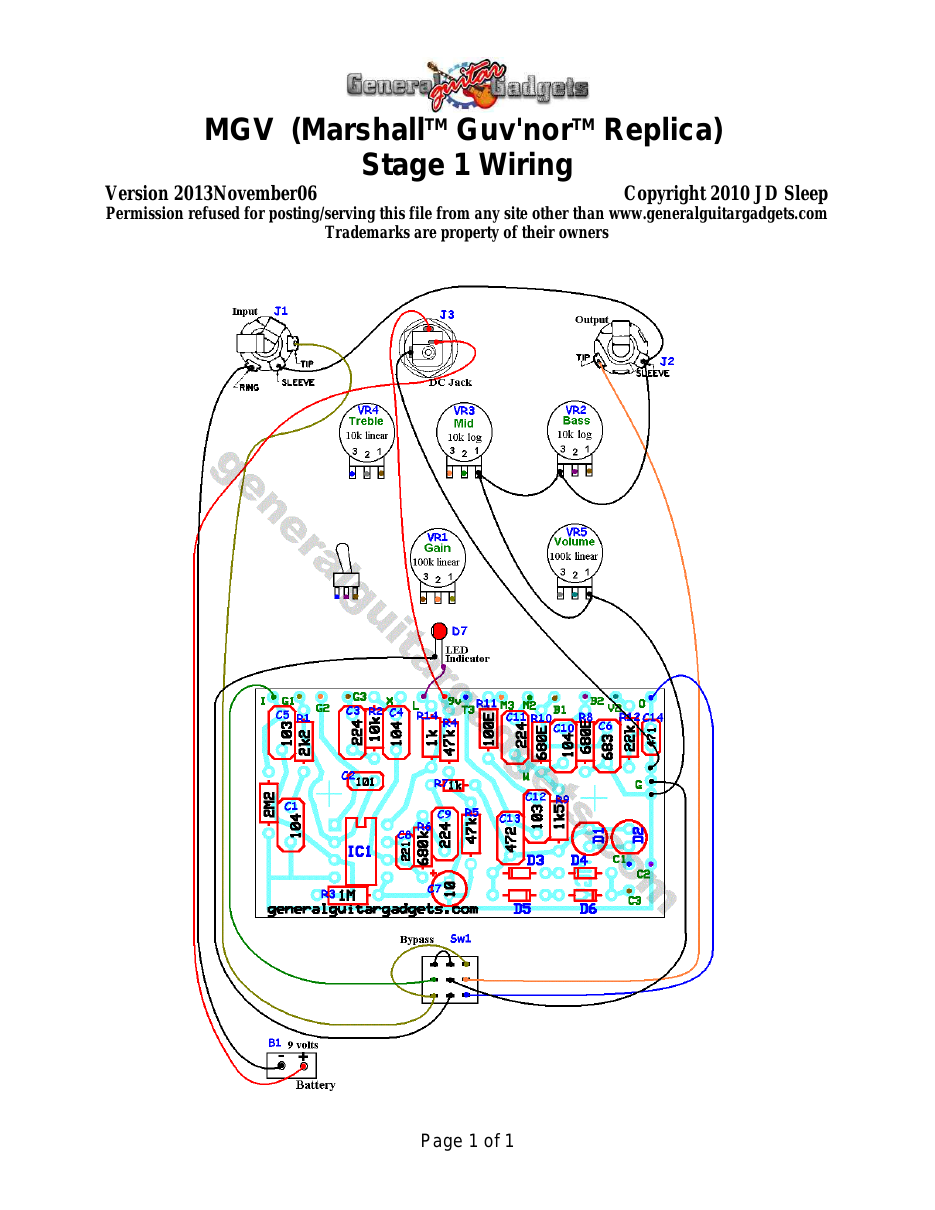
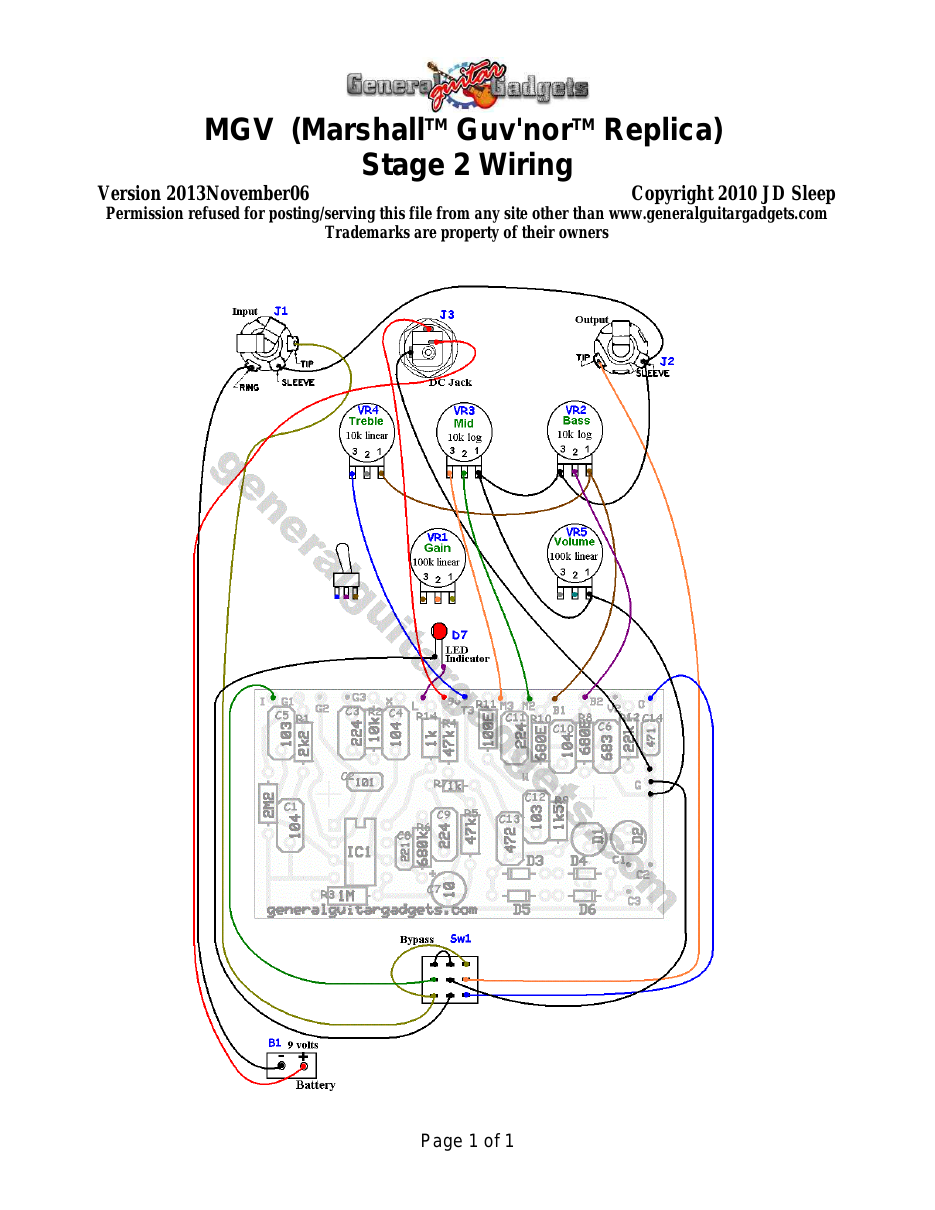
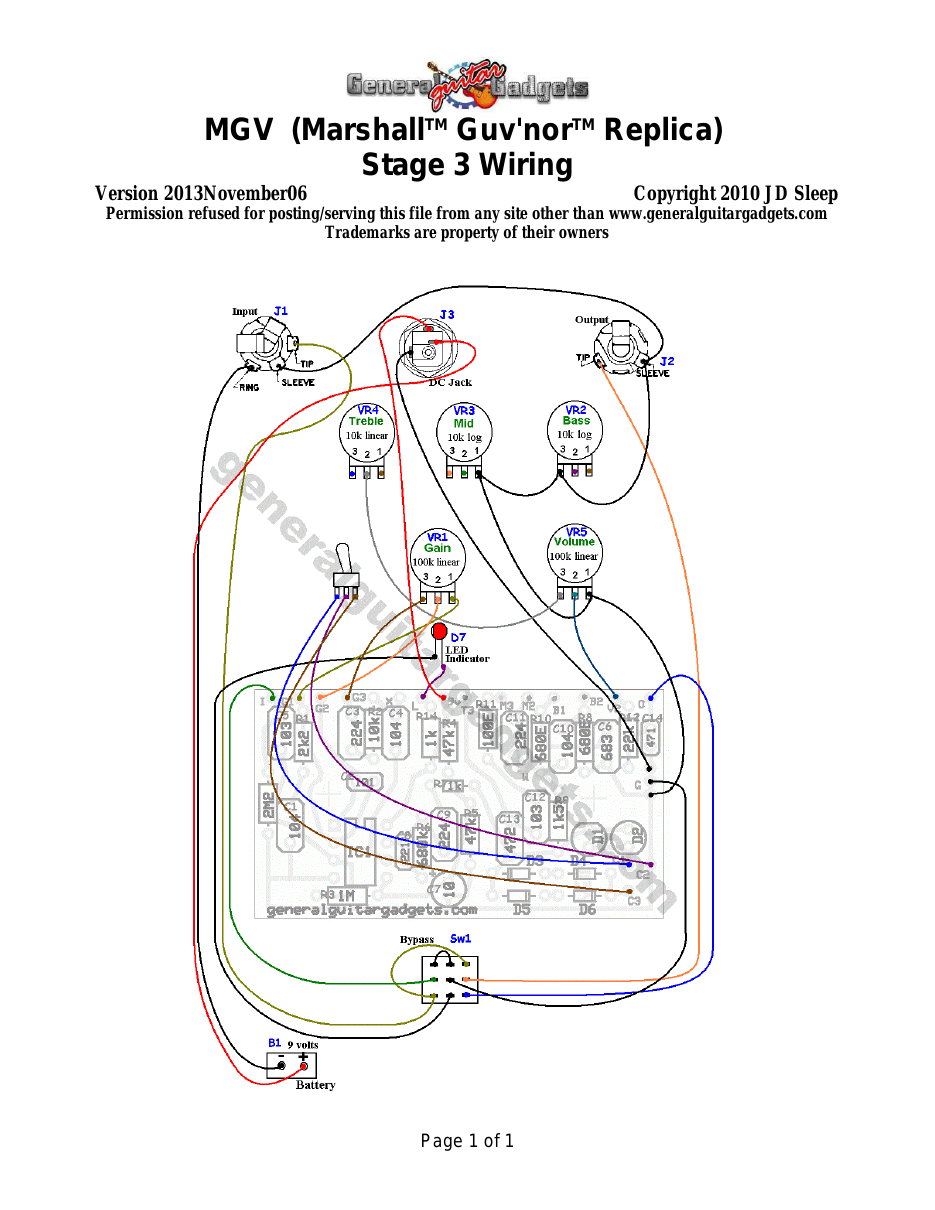
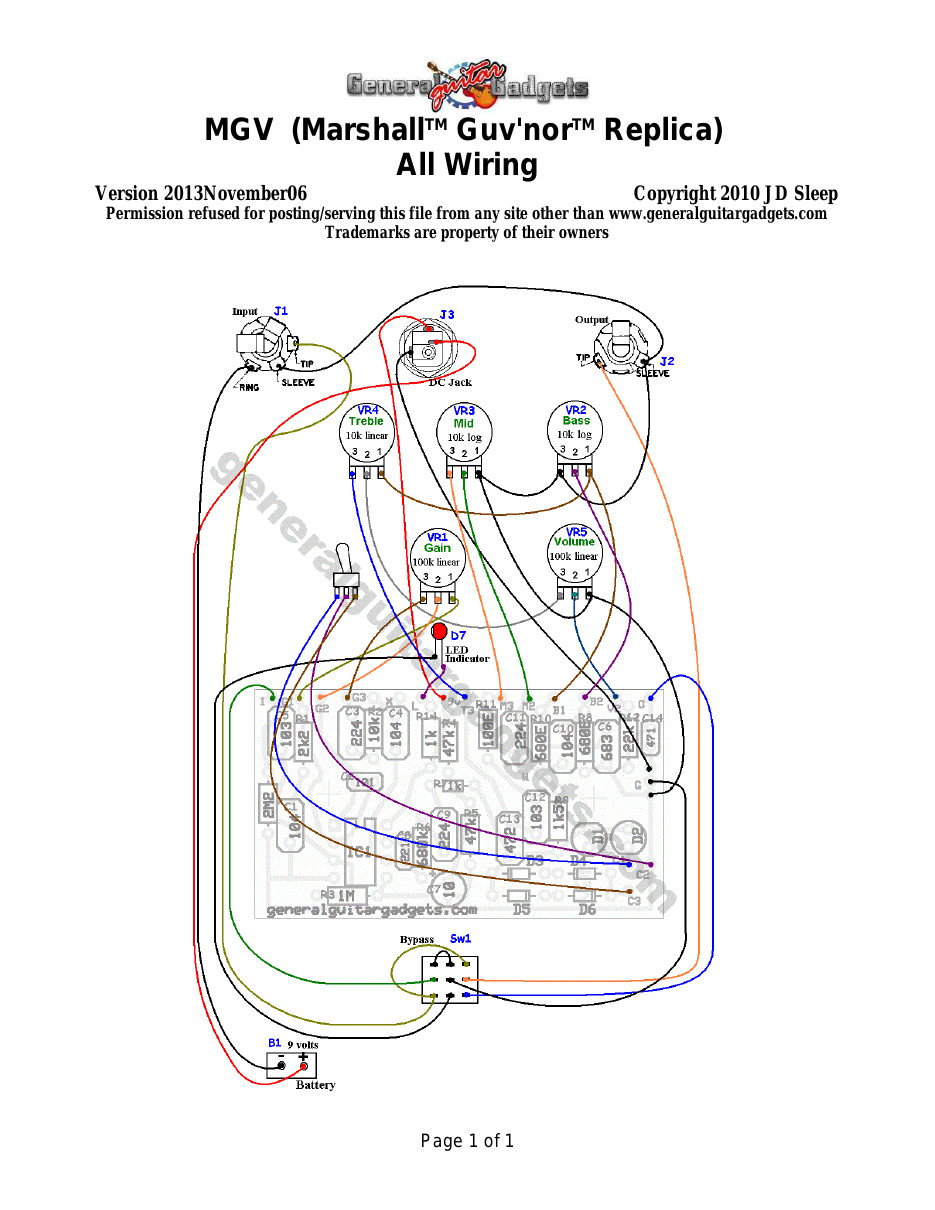
Parts Layout / Wiring Diagram
What you will need
Bill of Materials
Version 2013November06 · Copyright 2007 JD Sleep · Permission refused for posting/serving this file from any site other than www.generalguitargadgets.com · Trademarks are property of their owners
Resistors
| Resistor ID | Value | 3-band Marking | 4-band Marking |
|---|---|---|---|
| R1 | 2k2 (2.2k) | red-red-red | red-red-black-brown |
| R2 | 10k | brown-black-orange | brown-black-black-red |
| R3 | 1M | brown-black-green | brown-black-black-yellow |
| R4 | 47k | yellow-violet-orange | yellow-violet-black-red |
| R5 | 47k | yellow-violet-orange | yellow-violet-black-red |
| R6 | 680k | blue-gray-yellow | blue-gray-black-orange |
| R7 | 1k | brown-black-red | brown-black-black-brown |
| R8 | 680 ohm | blue-gray-brown | blue-gray-black-black |
| R9 | 1k5 (1.5k) | brown-green-red | brown-green-black-brown |
| R10 | 680 ohm | blue-gray-brown | blue-gray-black-black |
| R11 | 100 ohm | brown-black-brown | brown-black-black-black |
| R12 | 22k | red-red-orange | red-red-black-red |
| R13 | None | ||
| R14 | 1k | brown-black-red | brown-black-black-brown |
| R15 | None | ||
| R16 | 2M2 (2.2 M) | red-red-green | red-red-black-yellow |
Capacitors
| Capacitor ID | Value | Type | Possible Marking |
|---|---|---|---|
| C1 | 0.1µF | Film | 104 |
| C2 | 100pF | Ceramic or Film | 101 (or 100pF) |
| C3 | 0.22µF | Film | 224 |
| C4 | 0.1µF | Film | 104 |
| C5 | 0.01µF | Film | 103 |
| C6 | 0.068µF | Film | 683 |
| C7 | 10µF | Aluminum Electrolytic | 10uF |
| C8 | 220pF | Ceramic or Film | 221 (or 220pF) |
| C9 | 0.22µF | Film | 224 |
| C10 | 0.1µF | Film | 104 |
| C11 | 0.22µF | Film | 224 |
| C12 | 0.01µF | Film | 103 |
| C13 | 0.0047µF | Film | 472 or 4n7k |
| C14 | 470pF | Ceramic or Film | 471 (or 470pF) |
Potentiometers
| Part ID | Value | Type |
|---|---|---|
| VR1 - Gain Control | 100k | Linear Taper |
| VR2 - Bass Tone Control | 10k | Log (or Audio) Taper |
| VR3 - Mid Tone Control | 10k | Log (or Audio) Taper |
| VR4 - Treble Tone Control | 10k | Linear Taper |
| VR5 - Volume | 100k | Linear Taper |
Other
| Part ID | Part Name |
|---|---|
| IC1 | TL072 or other dual opamp |
| D1, D2 | Red LEDs |
| D3, D4, D5, D6 (optional for clipper switching) (D4 and D6 are option for variations on clipping) | 1N914 Diodes |
| D7 | LED |
| J1 | Stereo quarter-inch jack |
| J2 | Mono quarter-inch jack |
| J3 | DC Jack |
| B1 | 9 volt battery (not included in the Kit) |
| Sw1 | Heavy Duty 3PDT foot switch |
| Sw2 (optional for clipper switching) | SPDT on-on toggle switch 9v battery snap, Printed Circuit Board, 24 gauge stranded wire, Enclosure, Knobs |
How to build it
Instructions
Version 2013November06 · Copyright 2007 JD Sleep · Permission refused for posting/serving this file from any site other than www.generalguitargadgets.com · Trademarks are property of their owners
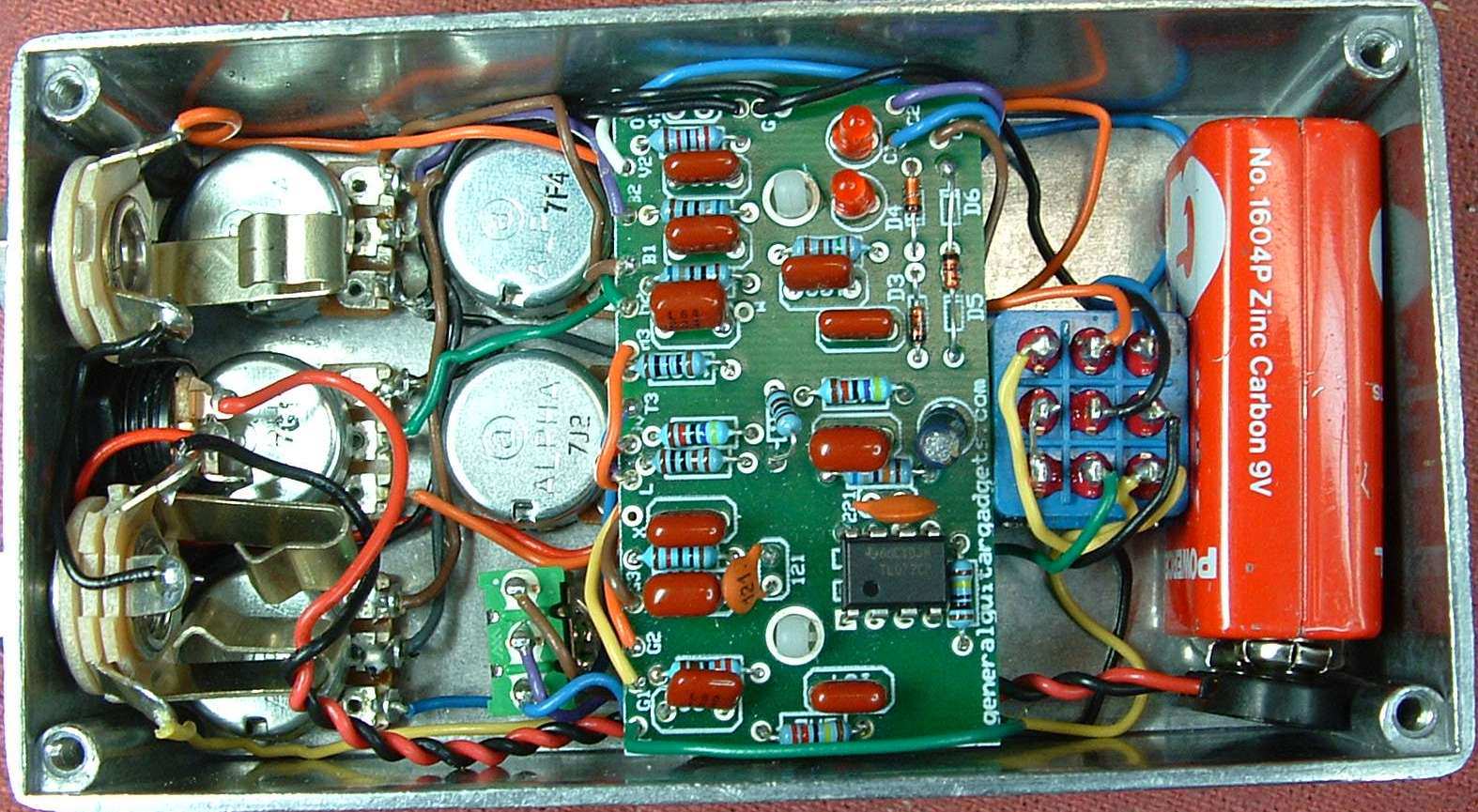
This is a replica of the MarshallTM Guv'norTM Distortion referred to as MGV in these documents. Use the project documents provided, starting with the General Build Instructions. Follow the layout diagrams to add components to the PCB and the wiring diagrams to hook it all up. D3, D4, D5 and D6 are optional diode clippers, the kit supplies these in 1N914 diodes, but others could be used. They can be configured with two diode clippers, three diode clippers for asymmetric clipping (as the photo below shows) or as a pair of 2 two diodes in series for smooth distortion (same clipper setup as the BluesBreaker™). The wiring diagram shows a toggle switch to switch from the LED clippers to these optional clippers. Note that if you do not use D4 or D6 diodes, D3 or D5 can be inserted across both diode placements and no jumper is needed, as shown with D5 in the photo below (the last photo in this document). R14 should be a 1k resistor. This is different from the original schematic with a 4k7 resistor for the LED current limiting resistor. The 1k resistor works better for the LED that we supply with the kit. Since the kit is a tight fit in a 125B enclosure, the following are some tips for putting the smaller one together. 1. Build up the PCB with all the parts and also the wires in the off-board wiring pads.
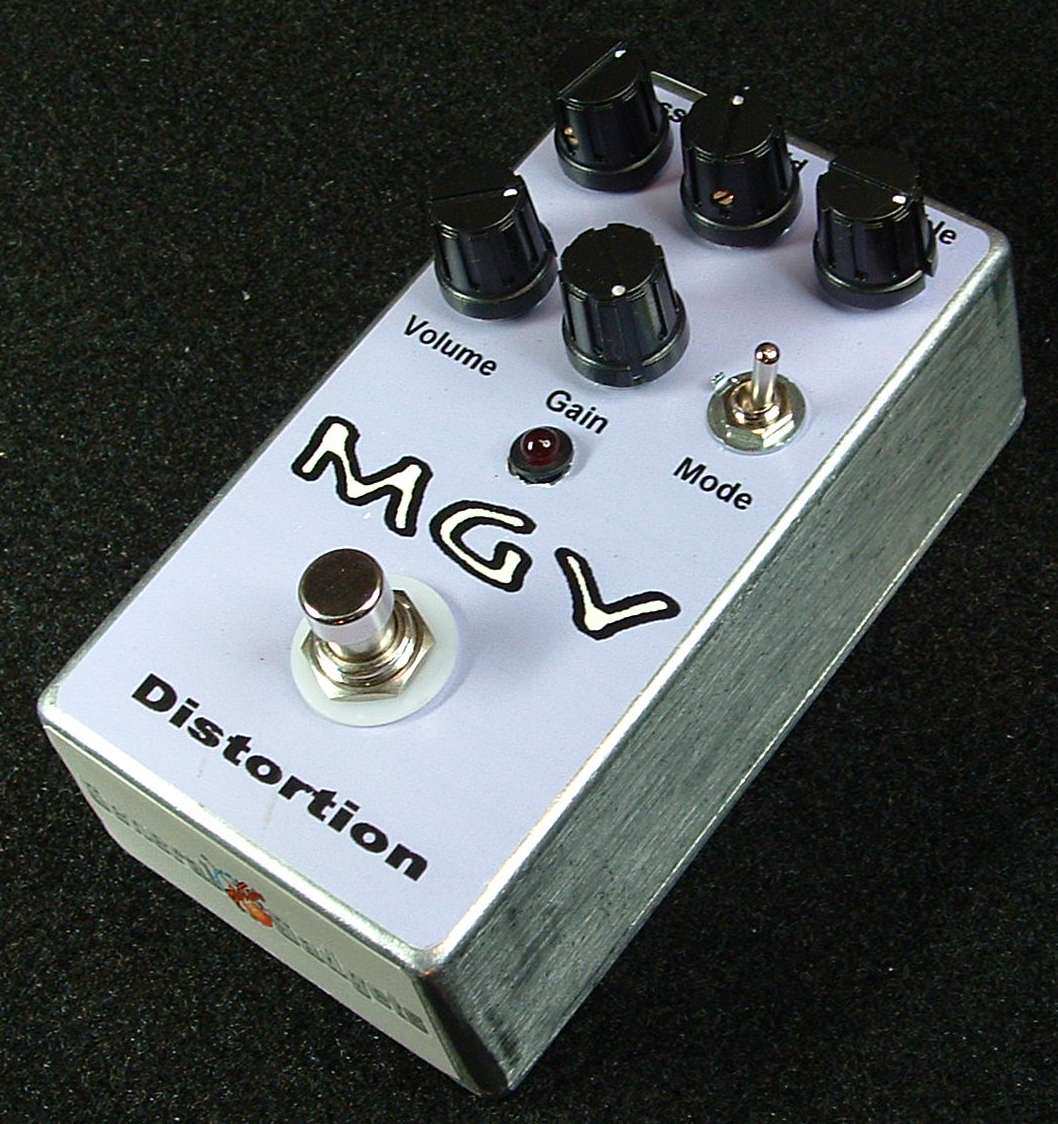
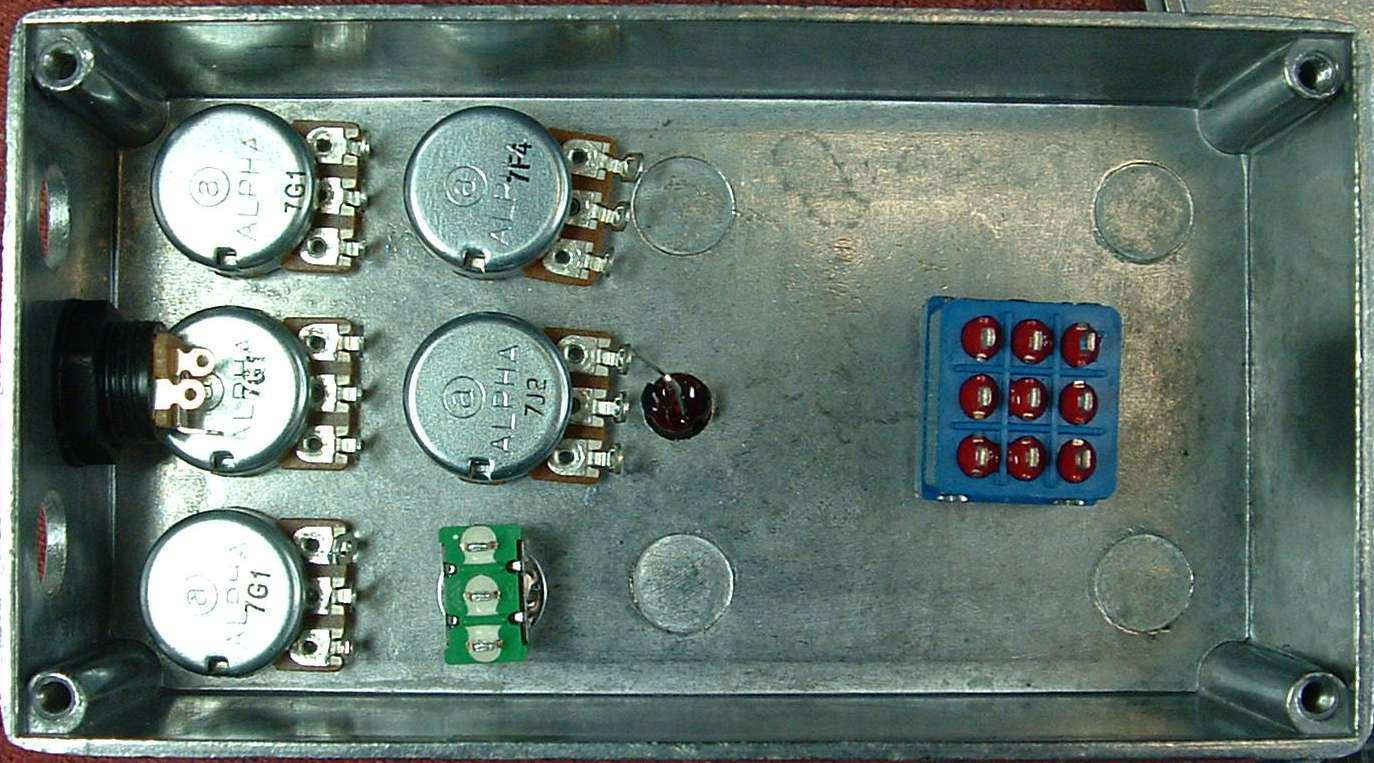
2. In the enclosure, start by installing the pots, switches, LED and DC jack, but not the in/out jacks yet.
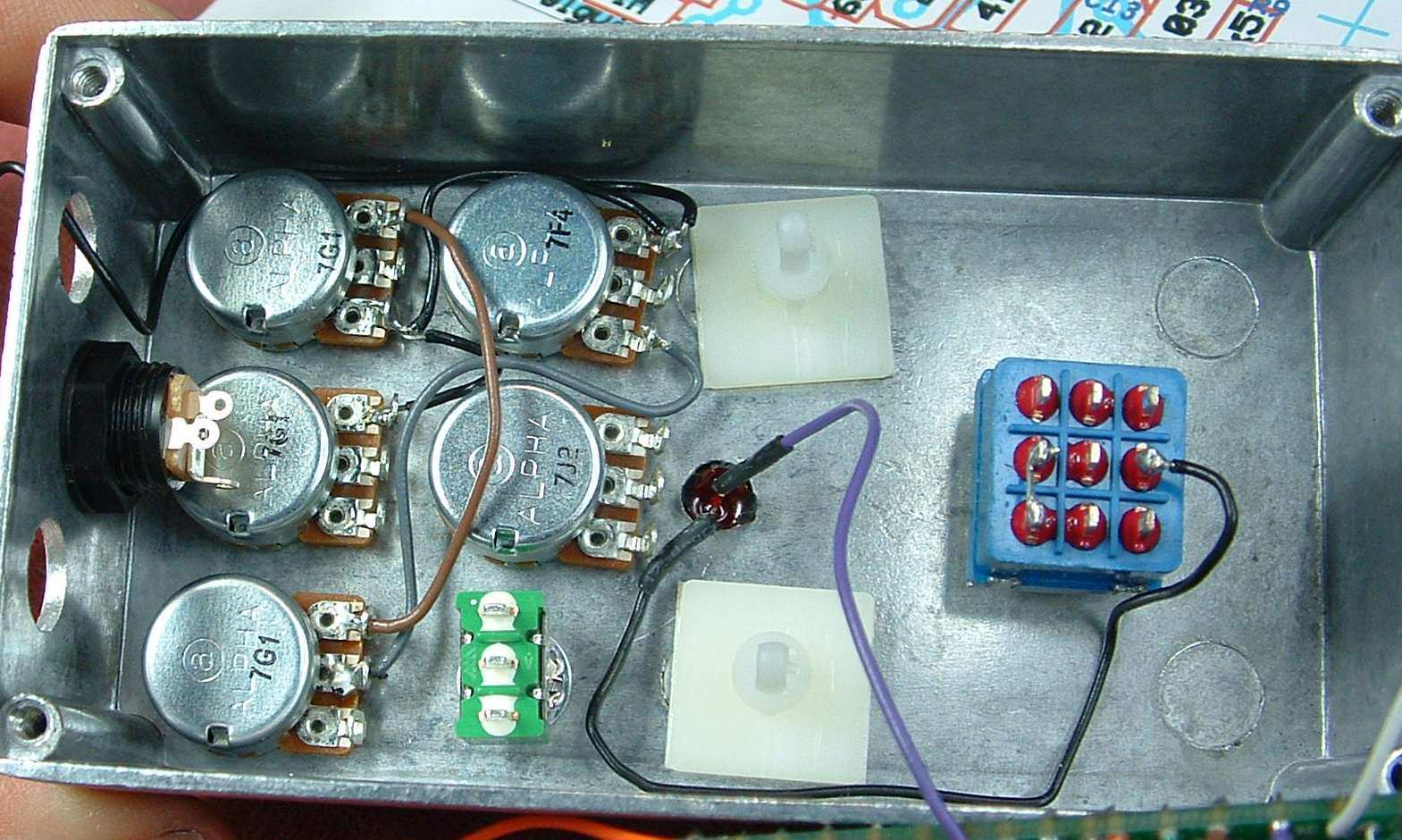
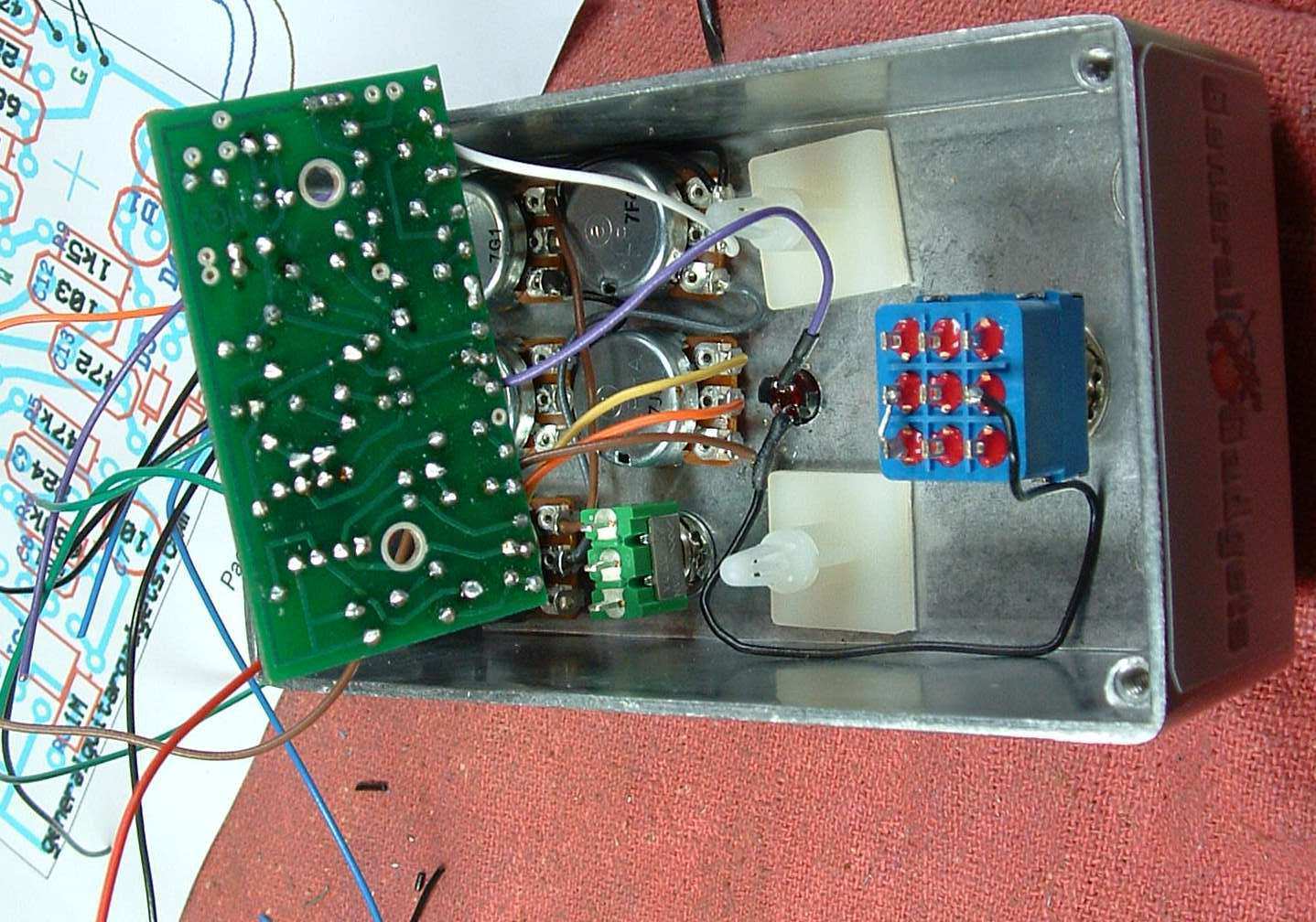
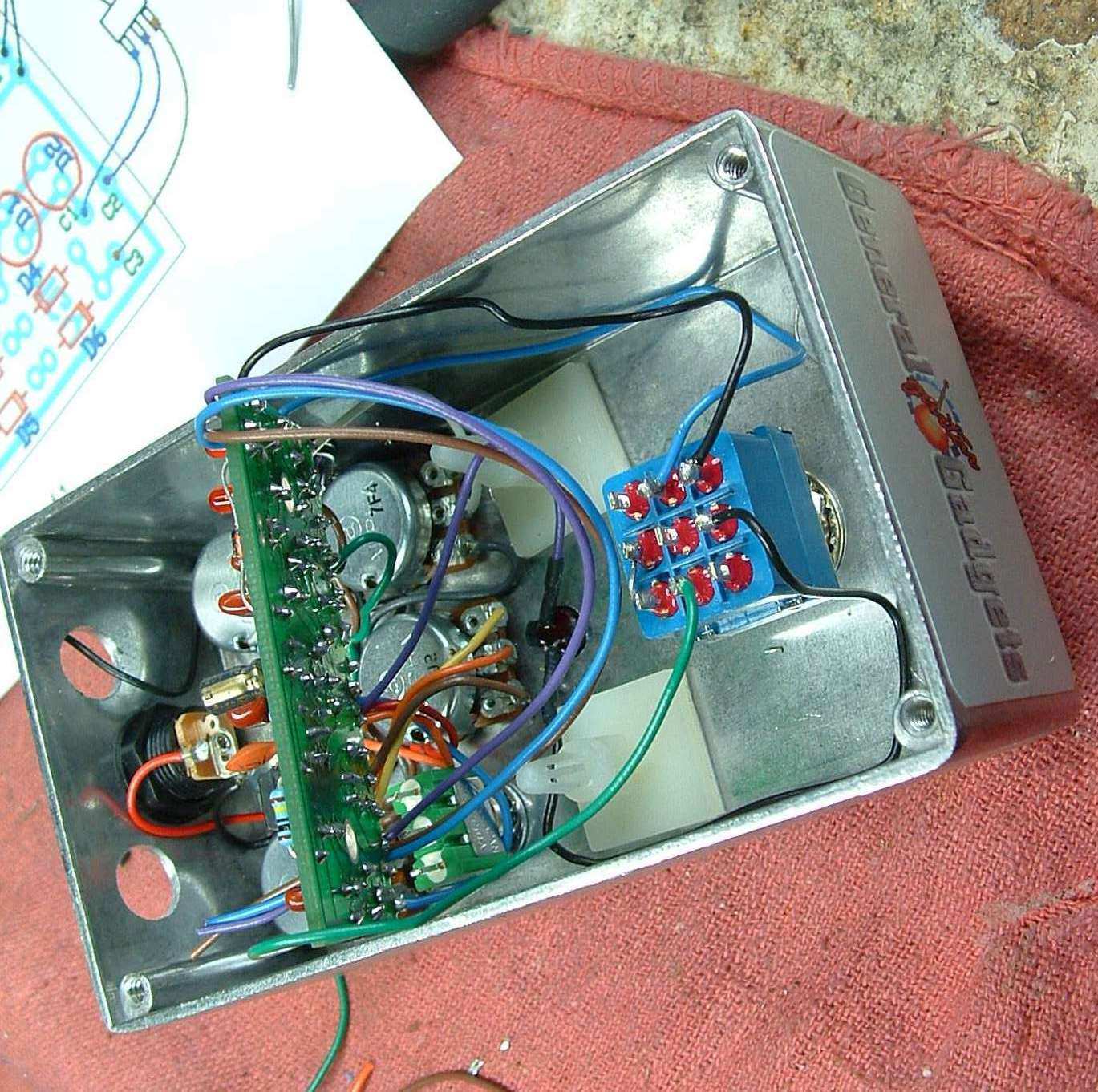
3. Plug the plastic standoffs into the PCB, expose the sticky bases and set the PCB in place, then remove the PCB, this sets the standoffs in place. It's easier to do this before you start adding wires inside the enclosure, although you can see from the photo that we started wiring before we did this. 4. Install all the wiring between the parts in the enclosure. Jumper the two lugs on the foot switch.
5. Run a wire from the short leg of the LED to the switch 6. Run wires between the pots as shown in the photo and the “Stage 1” wiring
diagram. 7. The PCB sits over the LED and the lugs of the second row of pots, so we should wire these first before we set the PCB in place.
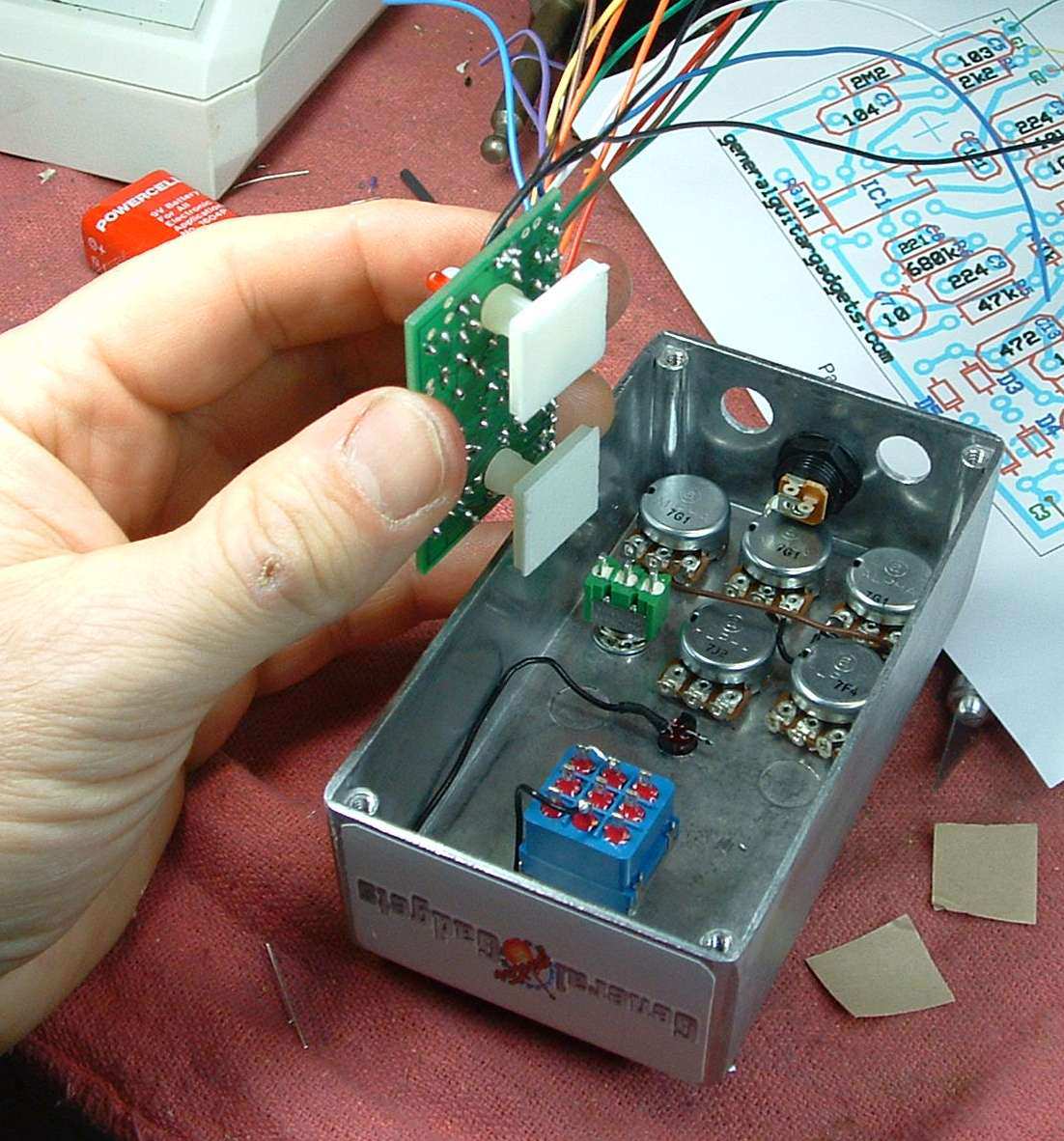
8. Next set the PCB back on the standoffs and do all the rest of the wiring except the toggle switch. Lift the PCB back up to run the wires under the PCB for the toggle switch wiring. 9. Set the PCB back in place, install the in/out jacks and wire them them in. Solder in the battery snap and you're done. A photo of the completed insides is shown below.
Comments and questions are welcome and can be sent to [email protected] Here is a chart of voltages taken at the IC pins. This information can be used to help you find and fix problems if your MGV doesn't work when you test it. These are approximate voltages, if yours are within 0.5 volt variance, you are probably okay, however, pin 4 should be zero volts and pin 8 should be same voltage as the 9v+
Component
Location
9 volt power supply IC1
Voltage
9v
Pin 1
4.5v
Pin 2
4.5v
Pin 3
4.2v
Pin 4
0v
Pin 5
4.5v
Pin 6
4.5v
Pin 7
4.5v
Pin 8
9v
Here's a view of the inside of the completed MarshallTM Guv'norTM replica in the smaller enclosure.
More about this project
Notes, sounds and related links
Ready to build? We have the kit.
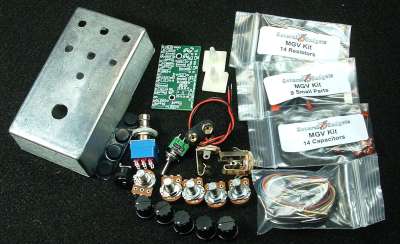
Buy a MGV Complete Kit. Includes all the parts and materials you need to build one, all for about the price you would pay for a PCB and parts.
Would you like a Ready to Solder Circuit Board for this project? Note: If you buy the kit, the Ready-to-Solder Printed Circuit Board (RTS PCB) is included in the kit. You do not need to purchase this Ready to Solder Circuit Printed Board if you buy the kit.